Exercise 3.1 Making your thinking and references visible.
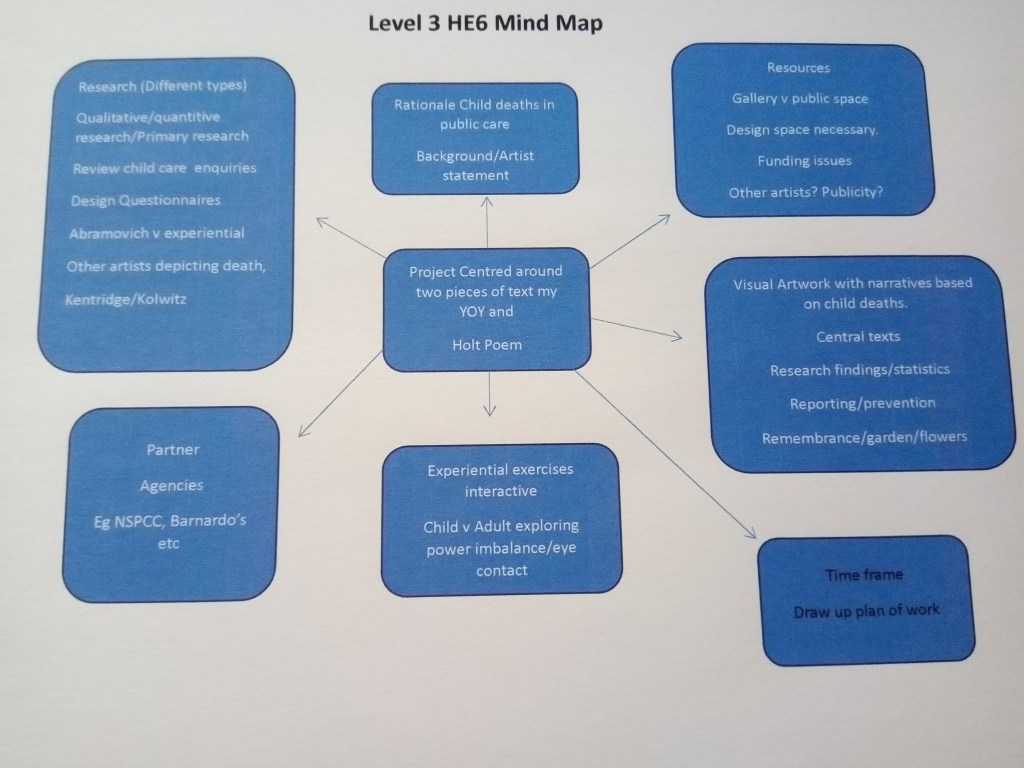
The mind mapping and concept mapping will be a really useful tool for me. I plan to build on the first plan of ideas or mind map that I did on the computer. A copy of this is below. In some ways I shall break down each segment on the map but will allow the mind to just flow and concentrate on relevant related issues.
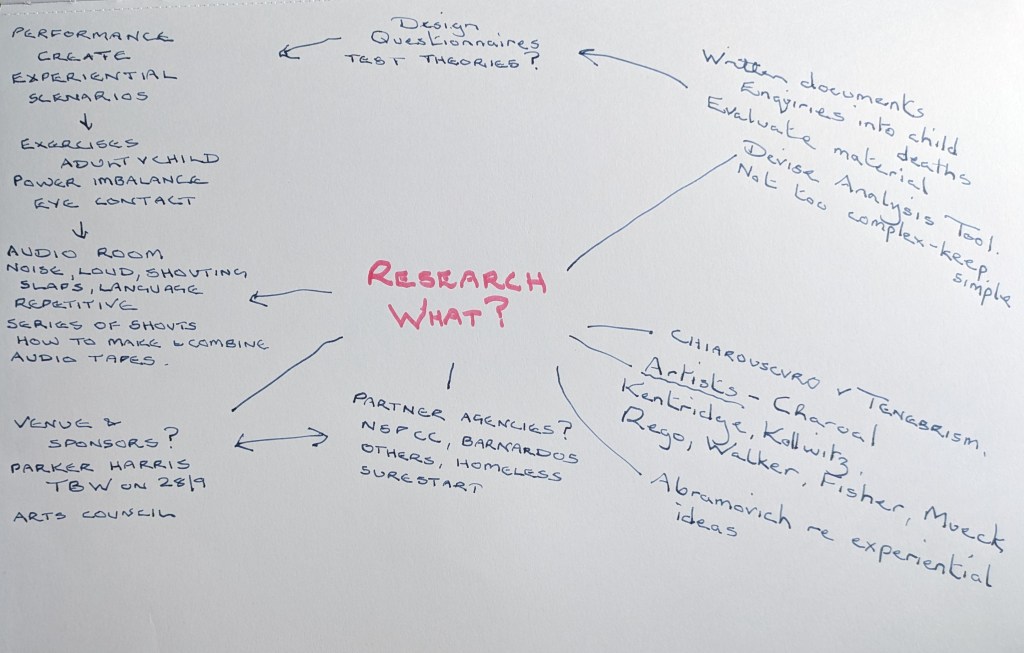
This first map relates to the research of other artists using charcoal and the different issues around exploring its properties. I shall draw on both modern day artists and some more historic classic artists that used the chiaroscuro v tenebrism techniques also in paint.

Below is my second concept map and I’ve focussed on the performance. I plan on acting out a scenario based on a mixture of true events. There is no real acting involved but each participant takes on a role as I read through events that unfold. There will be certain junctures where it is appropriate to explore feelings of the person in that role. There will also be identifiable times where interventions may have prevented the outcome. I shall need to involve a few people or the audience maybe and I need to explore the logistics of it being a one off video performance or whether it could be repeated daily. I have just invested in a 360 camera but don’t yet have a clue how it works. I’m hoping to video some charcoal work soon as well as this scenario.

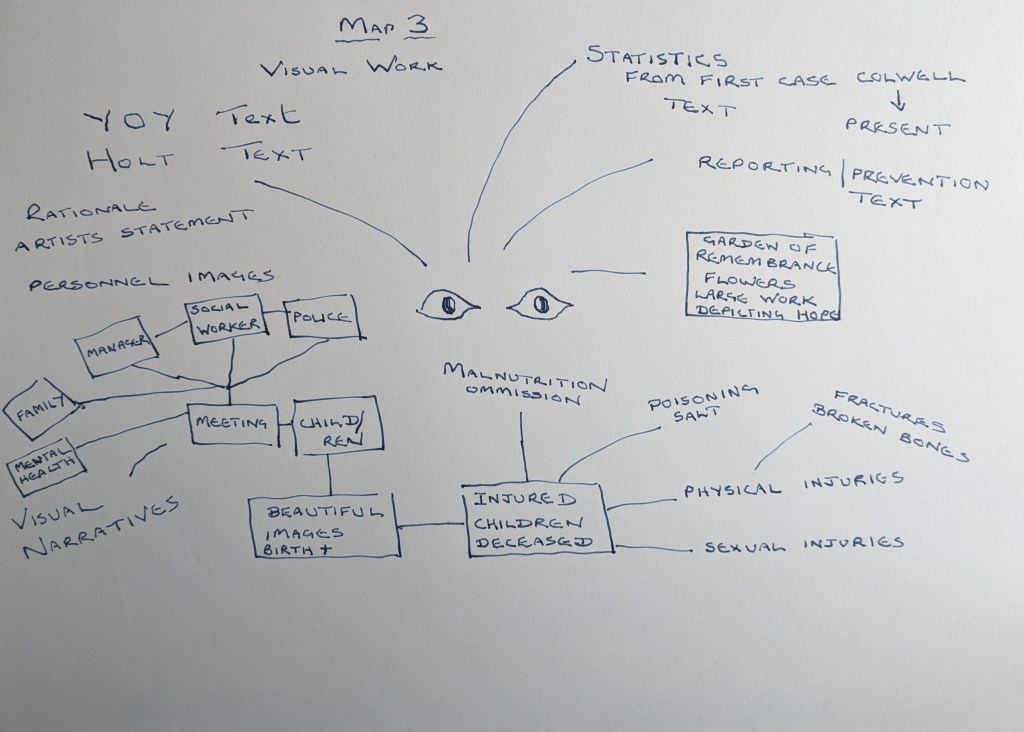
Concept map 3 below considers all the visual images and texts. This is quite self explanatory but in essence it includes all the texts and written information plus all the visual images.
This map 4 considers the galley space necessary and acts as a visual walkthrough and the transition of moving through a range of information and experiences. I plan to give everyone that attends the exhibition a copy of the Nolte text. I have spelt this wrong on my diagrams. The text is by Dorothy Law Nolte. It is one of my favourite texts and holds important values about how children should be cared for.
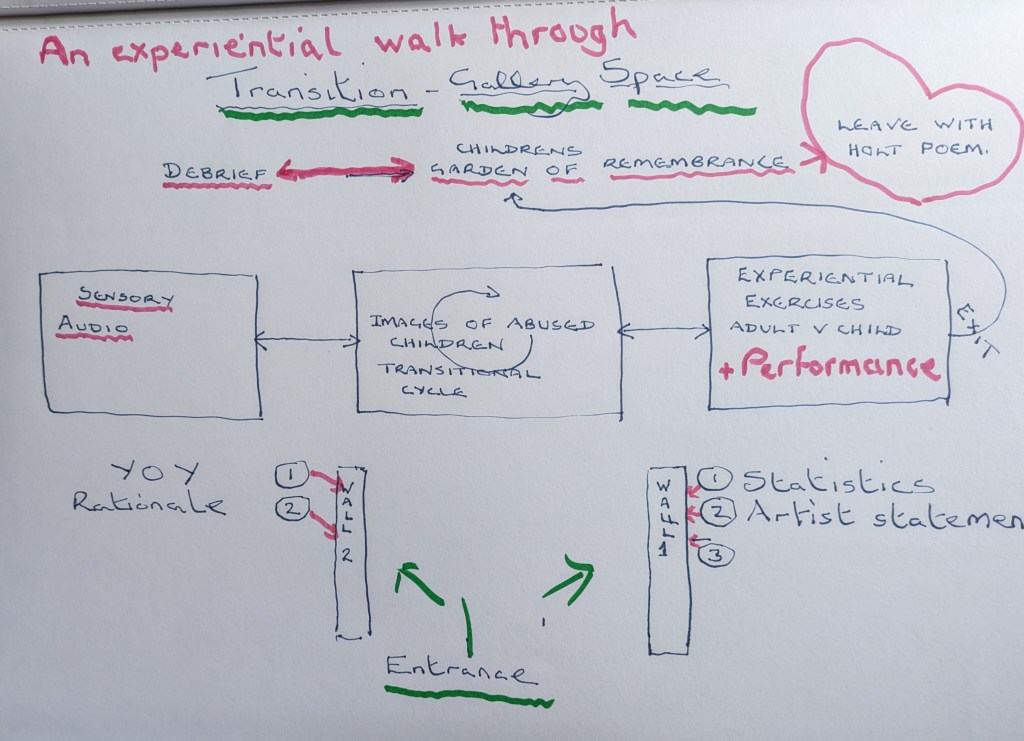
On the map above the audio sensory idea came in part from an artist we’d researched but I can’t remember who it was. The artist had someone listen to auditory statements that disorientated the person. If I can find who it was I will include this and do further research. I think it might have been POP 2?
My maps are not written in stone, but they have helped me to formulate and think through ideas more clearly. I have really enjoyed the way this first part of the course has been structured as it really helps you to think laterally and well outside the box. It has also helped me reflect on some of the past artists we have researched and how valuable their work has been in flagging up ideas techniques and practices that can be explored more in regard to using some aspects in my own work.
Exercise 3.2 Three dimensional mapping
For this exercise I’ve decided to try to replicate in 3D the kind of gallery space that would ideally suit my work. I managed to find a small corrugated black lined piece of packaging. It was a small tray. The colour attracted me as some of the walls in the gallery are good to be dark to suit my work. I made some sections out of some polystyrene black mount that would usually border a picture frame. I managed to fix all the sides together with some double sided sticky tape. My first image of the assemblage is below.
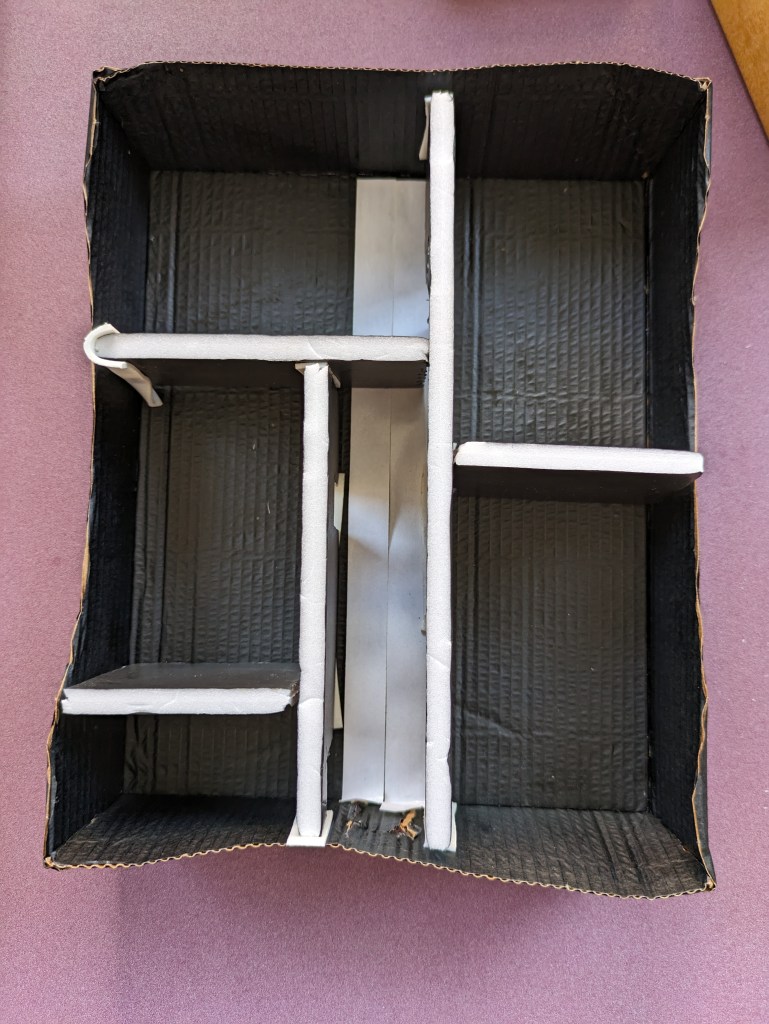
It’s not brilliant in shape but it was dark and it sectioned off okay. From this point I labelled the different rooms as below and added these with prit stick. The final image of the work is below.

The entrance would contain the YOY and information about the artists statement. There will also include some explanation of what might be expected in regard to no obligation participation, but to encourage participation to fully experience the intent of the artist in raising awareness of the issues. The first small room is the auditory sensory room which then leads to the eye contact experience. We explore feelings and issues of body and eye awareness in regard to power issues and vulnerability. The transition is then to the gallery where all the visual images positive images through to the more gruesome. The next stage will be for the performance room where the scenario that will lead to a child’s death will be talked through with participants taking on a role. Feelings are explored at different junctures and we identify various points where intervention may have prevented the outcome. All participants will be debriefed from role as they then make the transition to the remembrance garden/large image of flower painting each flower to represent a child’s death. Other info will include advice literature and the Nolte poem. This exercise helped to crystalise a few of the issues. For example the auditory room might be small like a booth and use of headphones might be more appropriate.
The mapping has been a very useful tool. I’ve since added some research and other ideas to them. They will now be my working tools. I’ve also begun to section off in folders the different pieces of research that will underpin the body of work and the exhibition.
 Endless Possibilities