Exercise 1.1 Sorting and categorising
This exercise has been a pivotal landmark. While I feel in some way it is a bit repetitive and similar to the mapping exercises, I think it has served me well in helping me to evaluate and almost hone down on my material and in the process I have changed what I thought was going to be my question.
As I began I decided to use several A3 sheets from my sketchbook. I looked at the exercise and the suggested categories and selected my appropriate headings. As I began to reflect on my material and my previously drafted question I found more clarity in what I was ultimately trying to achieve and what my project and work is all about. This became clearer when I was beginning to evaluate some of my findings through reading the child care inquiry documents. The notion of care will be intrinsic to what I’m doing and I suddenly realised how this would form the basis for a lot of my arguments and analysis of findings.
I created my headings and began to put some of my research under each category. I have amasses a lot of material in folders under artists, pages of internet stored in favourites and bookmarks, as well as my book sources, catalogues, child care inquiries and govt reports are in another folder. I do feel I’ve amassed quite a lot.
The above shows the photo of my collated A3 sheets.
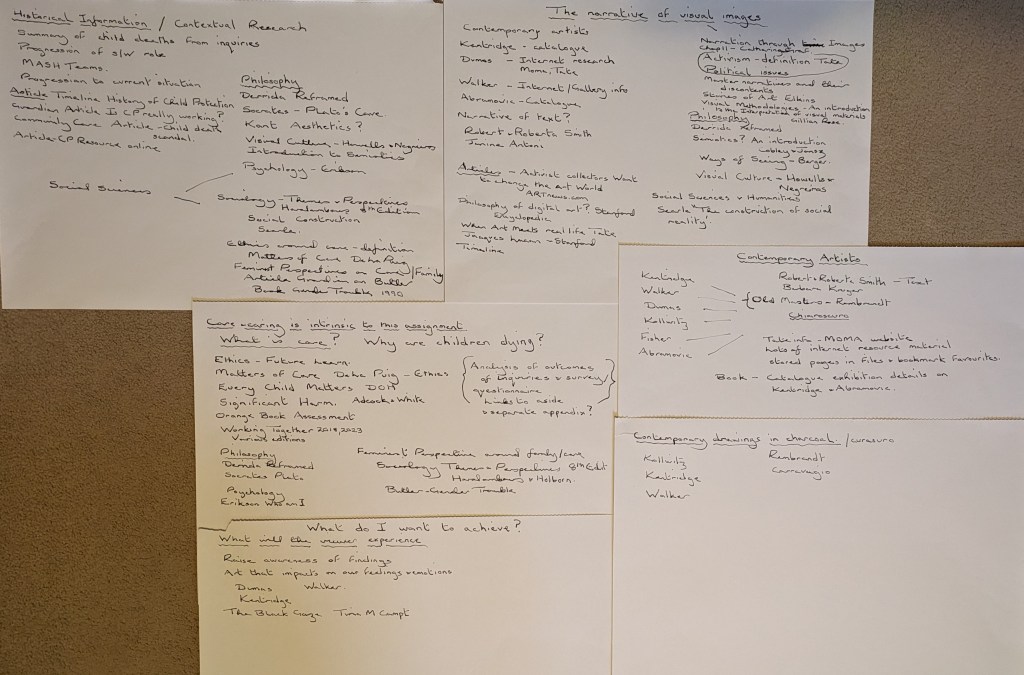
As I looked further and studied these it became clearer and not too difficult to select the main three headings. A lot of the material was overlapping and I could see how it could all mainly fall into the three categories.
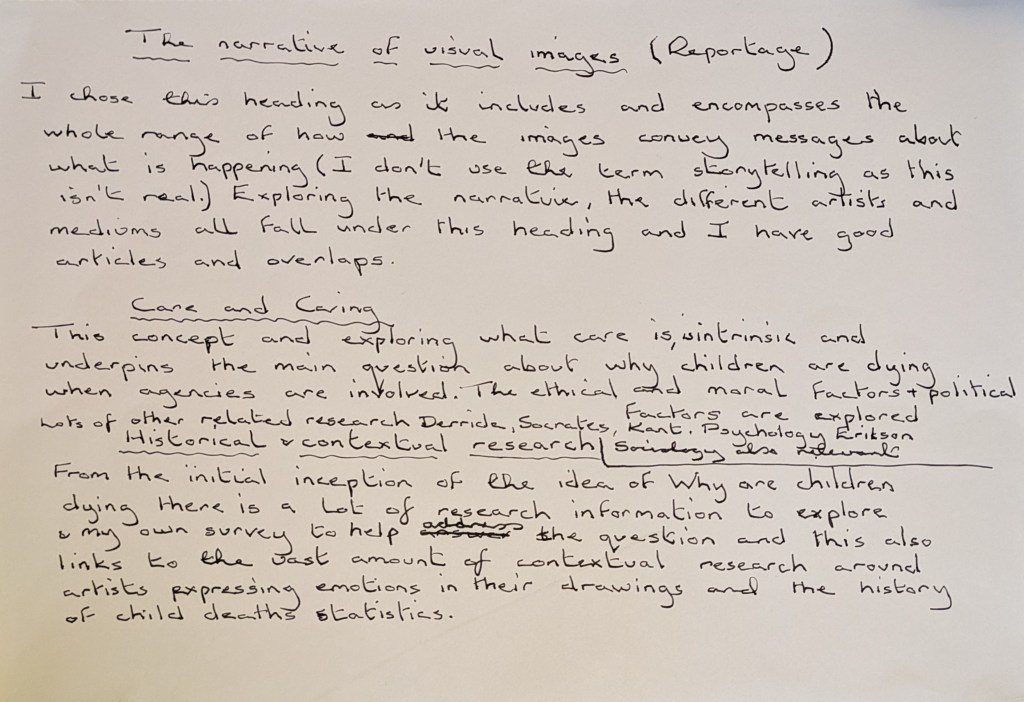
I added into the narrative section title the word reportage as this is also what some artists are doing and perhaps this is a less radical word to use instead of activism? Perhaps I can also look at this if appropriate.
I am very conscious that I might not be undertaking these exercises to the letter but for me its all about how I learn and we all learn differently and at a different pace. I tend to do a lot of reflection and I do take advice readily.
As I look and consider the material the narrative around death is important so my first sentence is;
How do artists visually portray the narrative of death or dying.
My second sentence is To define and critically examine the concept of care and care giving.
My third sentence would be to
Examine and explain why children are dying when there is statutory involvement that is there and designed to protect them.
Exercise 1.2 Exploring and uncovering
My first sentence will be around How do artists visually portray the narrative of death or dying.
My initial position on this question is based on research into various artists and many that portray such difficult subject matter use the medium of black and white usually charcoal and this sombre but versatile material suits the subject. The subject needs to be handled sensitively albeit the work should have some emotional reaction or response upon the viewer. If I am to raise awareness around these deaths and the vulnerability of children then I am hoping for an emotional response to the work. In contrast I will also explore further the concept of compassion fatigue. Are we less inclined to feel such emotions. ( Black Gaze, Campt and video interview)
I will compare and contrast the works of various artists, some using chiaroscuro like Rembrandt and other old masters to create drama, through to more contemporary artists like Kentridge and Dumas. I examine their use of materials and illustrate how their work impacts on the viewer. I will further evaluate their work and compare with to my intended body of work.
My second question is
To define and critically evaluate the concept of Care and Care giving.
My position on this so far and having read numerous inquiry reports there are clearly human failings around why children are dying. Too many children are dying. I don’t believe we care enough and as a society, I can’t help believe we are losing our moral compass. I am concerned that for whatever reason, and in spite of the outcome of inquiries we don’t act upon what we learn from the inquiries.
I shall define what is meant by the term care and examine the diverse nature of care. From the moral, ethical and social obligations of care, I shall consider and argue who ultimately has responsibility for the vulnerable children and adults in our society. I will explore the concept from a feminist perspective drawing on Butlers theories around gender conditioning in regard to performativity. I will also explore societal changes since the first death reported in 1944, the advancement of social media, changes in social care and health that may also offer some explanation around why care isn’t working effectively to protect these children. I will try to establish whether there is any correlation between societal changes and changes in the social care roles.
There is a strong link here to the concept of care and this will run and weave through my next question. They are not in order but my main question is about the deaths of children.
Examine and explain why children are dying when there is statutory involvement from various agencies that should protect them.
I had noticed quite a number of child deaths were hitting the headlines where there was statutory involvement and my project evolved to find out some explanation. There are a lot of demands on workers in the health and social care sector and I have many questions such as are workloads too high. Have the social problems changed and become more challenging. Are there issues about recruitment and employing the wrong kind of workers. Is the training workers get appropriate and effective. I was compelled to examine child care inquiry reports and find out more. From the inquiry reports I am finding lots of recommendations about the different agencies lack of working together effectively, a lack of sharing information and then taking appropriate action. Are workers skillful enough in assessing situations, parenting etc? How can we justify the the numbers of children dying. One report indicates that around 28 children will die each year. The information so far would suggest that the inquiries are a waste of time if we are not learning from them, taking action and improving these figures. I will need to define why an inquiry takes place.
I will provide an analysis of the information around child care inquiries since the first child death in 1944. I will also review my small survey of workers in Health and Social Care and discuss the outcomes.
Exercise 1.3 Revisit, Refine
I do believe that I am working now towards consolidating my question and have a really better structure to build around it and that flows well. I believe I must really concentrate on more reading around the inquiries and the books for relevant material. I received the Haralambos book today and I’m keen to find relevant arguments around societal change since the first death. It’s a fabulous book with such a lot of easy to understand material.
As I reflect on the work I’m developing I have been able to look at the drawings and these are developing well. I plan to draw 36 portraits of the children, some other charcoal drawings around vulnerability and also the narrative around a situation unfolding with different personnel. I’m also undertaking a relief sculpture. I’ve worked largely in charcoal and there are one or two drawings that contain colour. What I’ve done I can relate to other artists processes and subject matter around death. One of the main important factors for me was about how it feels when I am making these drawings of children who have died and the other drawings of children in very vulnerable situations where they are seen with a powerful adult towering over them. I feel such strong emotions as I begin to pick up the stick of charcoal. I have such an affinity with these children and they seem to spur me on to tell what happens. Kentridge also described how he felt bearing witness to others pain and suffering so these key similarities and experiences are linked also to motivation for such work. What drives Kentridge and Walker re racism, unfairness and injustice ignites similar passions in me.
Project 2 Critical perspectives
My first text to examine is around an appendix page to one of the inquiry reports. These are notes for consideration in the completion of a Serious Case Review report. One of the sentences states:
Is human motivation examined (for example, fear overwork, timidity, over-optimism, wilful blindness etc.?)
The next question underneath this statement is:
Is research-based evidence used? (And How)
This first sentence contains some really important issues about the human failings and more importantly that some of these are deliberate.
This leads me further to explore the concept of caring and whether those in vulnerable positions are cared about enough.
I include a passage from the book by Maria Puig de la Bellacassa, Matters of Care.
Maria de la Puig’s book explores a lot of themes and perspectives on care. While the preludes of care contain more information related to care from a feminist perspective which I shall also use in my review this paragraph is under the heading Noninnocent care and relates to the concept of permaculture and the complexities of how acts of care are realized.
‘Far from being an innocent activity, care in nature cultures can be purged from its predicaments: for example the tendency to pastoral paternalism, the power it gives to care takers, and their unequal depletion of resources it implies in existing divisions of labour and exploitation of humans and nonhumans. In some contexts, care is inseparable from killing: like in weeding one’s garden to make possible more fertile growth. As Haraway puts it, interspecies living is also about ‘mortal relatedness’ (Haraway 2007b) Engaging with the ethicality in these fraught questions, Haraway argued for refusing to make anything and anybody ‘killable.’
These two key texts almost suggest that killing is okay and in some cases necessary. I need to evaluate my material as if for example a workforce isn’t up to the job is it inevitable that children will die? It reminds me of war – justifiable homicide! Maybe I need to look at this. That last text also reminds me of Hitlers regime in creating the elite race and exterminating others. I could also bring in the pandemic around the choices/decisions about who lived and died.
My third and fourth text I link together to illustrate how women are determined to be in the care role and through exploring Butler’s view we have some explanation for this. My third text is also from Matters of Care Following some discussion around the ethical perception of care as something we do and feel Maria Puig de la Bellacassa raises issues around a feminist viewpoint:
Feminists have shown how much affective labour can be energy consuming and how it is even a commodity- for example in customer care or other services (Hochschild 1983: Vora 2009a ;Dowling 2012) In a world in which inequalities make of care a burden mostly carried by ones at the expense of others, ‘to care’ can be devouring for women and other marginalised carers. As suggested by Puig de la Bellacassa women are predominantly in the role of carer. If we consider the work of Judith Butler we have to question why this is the case. (Butler is introduce her……….) would suggest that women are more inclined to be in such roles due to social conditioning and performance of gender. Haralambos and Holborn 2013 state that ‘Butler not only believes that it is no longer sustainable to distinguish between masculinity and femininity but she also argues that the distinction between sex and gender is outdated. This is because she does not see sex as some sort of natural state and gender as a culturally determined set of behaviours. Rather, according to her point of view, both sex and gender are performances- people act out being male or female and act out being masculine or feminine, rather than being these things’
Project 3 The process of writing
I am following the intended structure for the written work. As previously stated, now that I have revised my approach and consolidated my question I feel more confident in knowing how to structure the work in a manner that is cohesive, concise and is able to flow well from one argument to another. I am following Cotterell and Gilda Williams books and taking advice on the aspects of critical thinking and developing arguments.
Project 4 Finalising your research question
My question is:
Why, when there is statutory involvement, are children in this country dying, and how do artists convey death and dying through visual images, that form an important narrative in their work.
The message people will take is an awareness of the statistics and the outcomes of the research/debate about why so many children are dying.
Exercise 4.1 Testing for robustness
I do not believe that children should die through the negligence of those who are supposed to protect them.
My view is that there were not so many deaths occurring in the past and I genuinely want to find out why. I believe I’m half way there with finding a number of reasons and I want my analysis and conclusion of my finding to be well researched and balanced. I’m not on a witch-hunt to run down the services and I hope to be quite objective in presenting the information.
My studio work and my experiences of undertaking this project have presented difficult challenges. When drawing the children I feel such a range of emotions and an affinity with them that drives me on. However its a dark subject and I guess others do perhaps question why I am following this pathway. I’m constantly reminded of Kentridge’s interview and I feel similarly to how he feels. There’s a compassion and strength driving me but I also want this project to be viewed positively. I also don’t want it to offend people or at worst the families of any of the real children.
Kentridge helps back up why I must continue. I don’t ever expect life or work to be easy. Both my experience as a child and my experience as a social worker helps spur me on to meet difficult challenges and ameliorate them.
One of my conclusions will be to have an overview of all the inquiries and this in itself may be quite illuminating so I must be thorough and work through as many as I can. We are talking well in excess of 300 at present and there will be more.
My main issue as I plan further is to read and finalise the inquiries. I also want to read up more on the Haralambos book around sociology as there is a wealth of information there. Ialso need to upload my questionnaire for approval.
My draft plan
My main tasks in order to complete my review are as follows:
Task 1 To complete and upload my survey and information sheet to the hub by 12/2/24
Task 2 To read up more of the child care documents by mid April
Task 3 To distribute questionnaire as soon as approved end of Feb
Task 4 Analyse questionnaires end March
Task 5 Read more Haralambos, Matters of Care, All other related research materials end April
Task 6 Draw up structure and create draft Work is in progress Mid April
Task 7 Finalise the review from feedback end June
My plan for the review is more straightforward now and I just need to consolidate all my notes and prioritise reading up more. My studio work is developing reasonably well and having looked at my plan of work for Advanced Practice my body of work I anticipated being complete by around August 24. I can’t say its been easy with deadlines for two lots of work in tandem, but I do feel I am making progress and getting used to this approach. I have been anticipating completing 36 portraits of children, and several drawings around the narrative of what happens to children. I also hope to complete two sculptural works.
Exercise 1 Return to your critical investigation to your studio practice
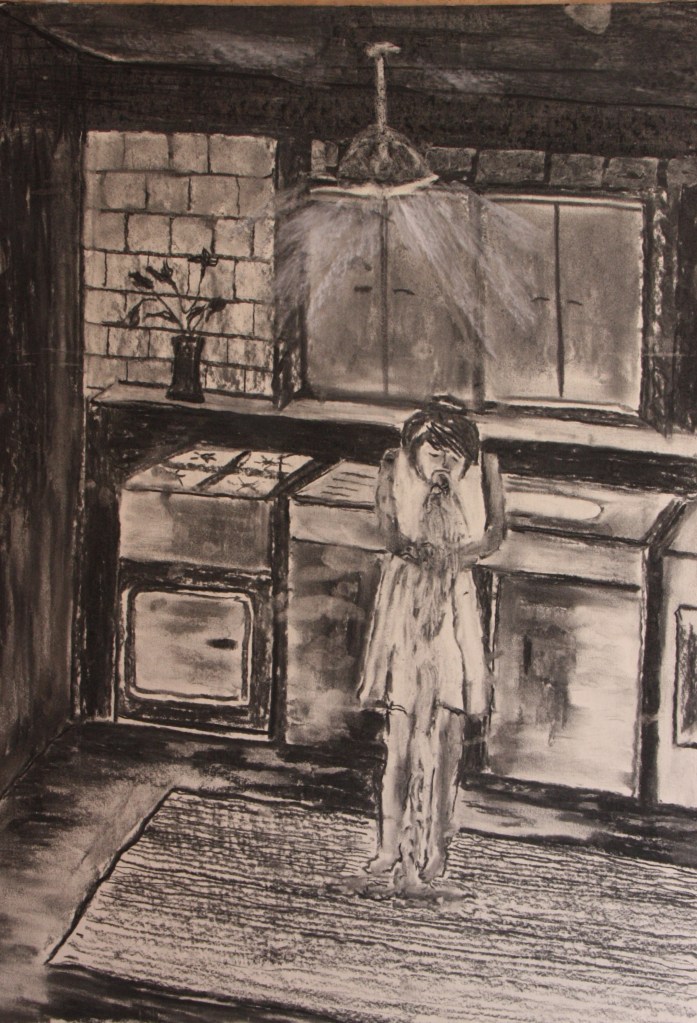
The two works that at this stage are important are about vulnerability of the child and power issues. The first depicts a child being physically sick and it is titled fear.
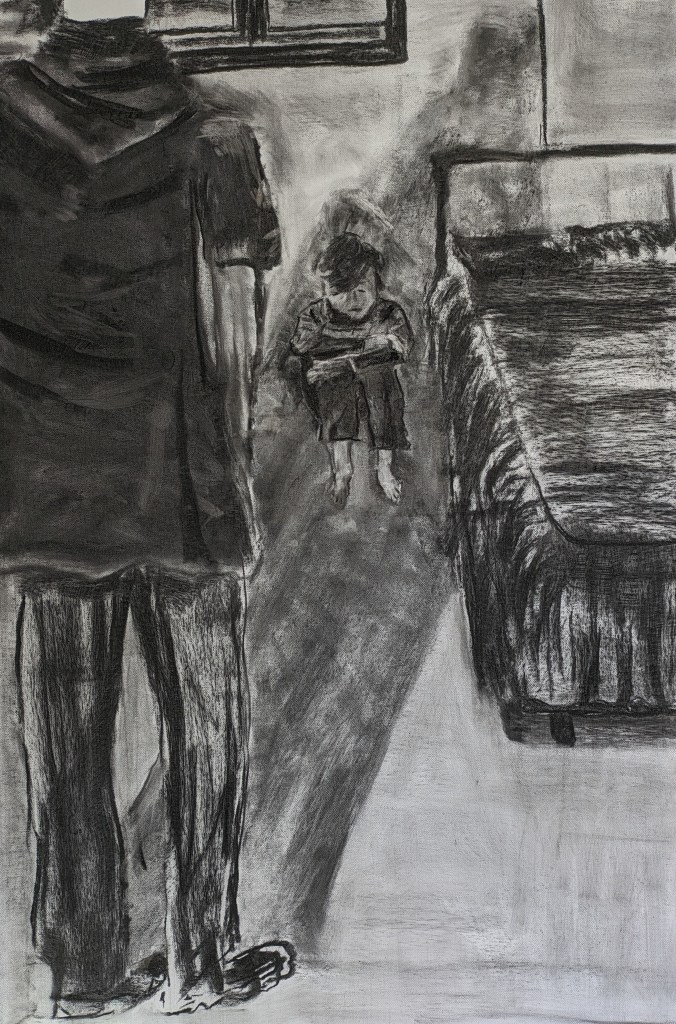
The second depicts a child huddled at the side of a bed almost hiding in the shadows of the adult. Hiding in the shadows is a befitting title.
The first work is a charcoal drawing on a piece of mount board. The work is sized 24ins by 16ins. I began to explore the beauty of charcoal in Drawing 2 and I just thoroughly enjoy the processes involved in creating drawings. The charcoal is so easy to use and my drawings began to improve through its use. I usually begin by drawing outlines of figures and then put in the main light and dark shapes. I work quickly as I find this helps me to become more accurate. I don’t worry about errors as these are so easily remedied through use of an eraser. I use both hard and soft erasers plus a fine mechanical eraser for finer light lines or highlights. Sometimes the erasure marks are visible and can be intended. For example erasure marks were really good on erasing foliage in one of my previous drawings. In this drawing the erasure marks are evident on the rush mat and in the light from the ceiling. As I work I concentrate of the lights and darks such as are reflected in the planes on the face or reflections from a window. I work around the face and figure until I am happy with the tonal qualities and that the shapes are all in the right place. Once I am happy with the drawing I will use a fixative spray so that the work is sealed and won’t smudge. I have just purchased a permanent fixative. With some fixatives you can work on further and fix in stages. I intend to mount and frame this work for my exhibition. I believe the use of charcoal suits what my project is about. I don’t use any other colour and the contrasting black and white creates dramatic effects. I imagine at this stage that this work will be displayed with other similar work on my theme that show the vulnerability of children in abusive situations.
My second drawing is also in charcoal but this time I use a large 36×24 inch canvas. When I first embarked on using canvas I wasn’t sure how it would work but I had completed one before and I was able to seal it with hairspray. I now use professional fixative as I am advise through research that this can become yellow over time. This drawing is my second of this kind of nature. I created the shadows and the illusion that the boy is almost huddled in fear hiding. I hope its descriptive enough. Some might question why he’snot on the bed. This is deliberate as a lot of abuse takes place on or in a bed. Again I draw my main outlines of the drawing and then block in my main shapes. The process of erasure and redrawing is continuous until I feel I’m happy with the outcome. I plan to display this unframed and I have several other drawings of this size that I hope to display in an exhibition together.
 Endless Possibilities