The opening paragraph by Roni Horn really resonates with me. I love how he referred to a changing landscape in his description of seeing more in the same book or text through returning to it and re-reading. How we look at things and from different angles or perspectives provides such a richness. It never ceases to amaze me how different people see different things in a work of art. We view things through very individual eyes and our personal experiences and our views of the world often result in the interplay between the subject and what we see or perceive there to be. If I relate these issues more directly to my work and processes, I often leave a work in progress and return to it after a few hours or longer a day or even several days. Sometimes it may be weeks. It’s like you return with fresh eyes and see things you didn’t see before. Kentridge taught me that there is no bad drawing and this not only gives me confidence but the drawings continue to improve. With the charcoal I’m looking at my subject intently and my hand simultaneously draws the marks. I refine or rectify marks quickly and easily through erasure or smudging. These issues also remind me of a book that has quite an impression on me, John Berger and the Ways of Seeing. It was particularly poignant about how male artists viewed and depicted their female subjects in often a demeaning or derogatory manner.
Listening point
I further accessed the listening point with Philip Guston. He begins with the words destruction and that this is part of the process and that this is crucial. Again I can well understand that for him this is part of his process. On occasions this has been mine too. I’ve sometimes wiped off the whole canvas and been left with the traces which have looked good to start from again. I do think that as we progress as artists we begin to consolidate our processes and practices through vital experiments that push and challenge us constantly, testing various materials and subjects. Guston mentions something mysterious at work and I do think he’s right. I sometimes just don’t understand fully how I get to the end result.
Exercise 1 Return and review
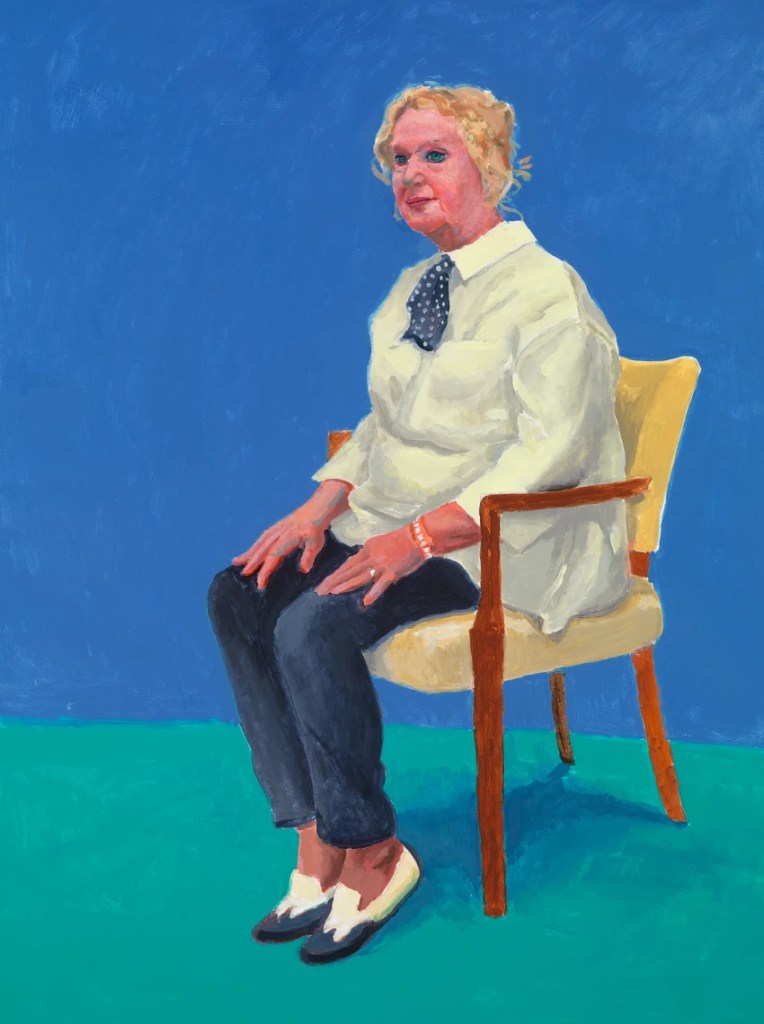
I am very conscious that it is still early days for me in working with this new found confidence and creating work in charcoal. I do really believe now that my artistic voice is developing in a way that I would never have imagined. My social conscience keeps being prompted now and is reflected in the work I am creating. Injustice and unfairness are definitely some of the characteristics I need to challenge in some way through my art. The statement by Joseph Crigley is so true. What has nothing to do with art, has everything to do with art, and this I guess is where I’m at. I reflect a lot on such atrocities against people in the world around us, and so far away in real lived war zones. For now I concentrate on what is happening closer to home and in this country. In some ways it would be good to talk to those in government who might legislate and help things to improve but sadly I have little faith in politicians. I do believe in God but I don’t currently attend a church. I am more inclined to my relationship with God being reflected when out in the countryside walking. It would be great to have some explanation about why the injustices occur but there are no real answers from religion, so I won’t get into debate. As I return and review my work the portraits are about capturing all the light and dark shapes and contours of the face. Erasing and redrawing is quick and easy as I strive for accuracy. As I’ve already stated in part 2, I am really feeling a strong emotional connection to these children with each mark I make on the canvas. The more I draw the more I also remind myself that these portraits are to celebrate their short lives, so not difficult visualisations. In this regard I have begun to adjust my portraits and giving them a coloured background. My tutor commented on how colour changes the temperature of a drawing. I can see how this applies. While I still want to work in charcoal I am also conscious that some of the faces will be smiling and these portraits are intended to reflect in some ways happier times. I’m testing out Hockney’s blue background for portraits and also a bright orange. The blue reflects bright blue skies and the orange reflects sunshine. Some of Hockney’s images are below and were from his exhibition at the Royal Academy.
https://www.royalacademy.org.uk/exhibition/david-hockney-portraits Accessed 31st December 2023
The portrait below is of Celia Birtwell often a sitter for Hockney. It was painted on 31st August,1st, 2nd Sept 2015. Acrylic on canvas 121.9 x 91.4cm
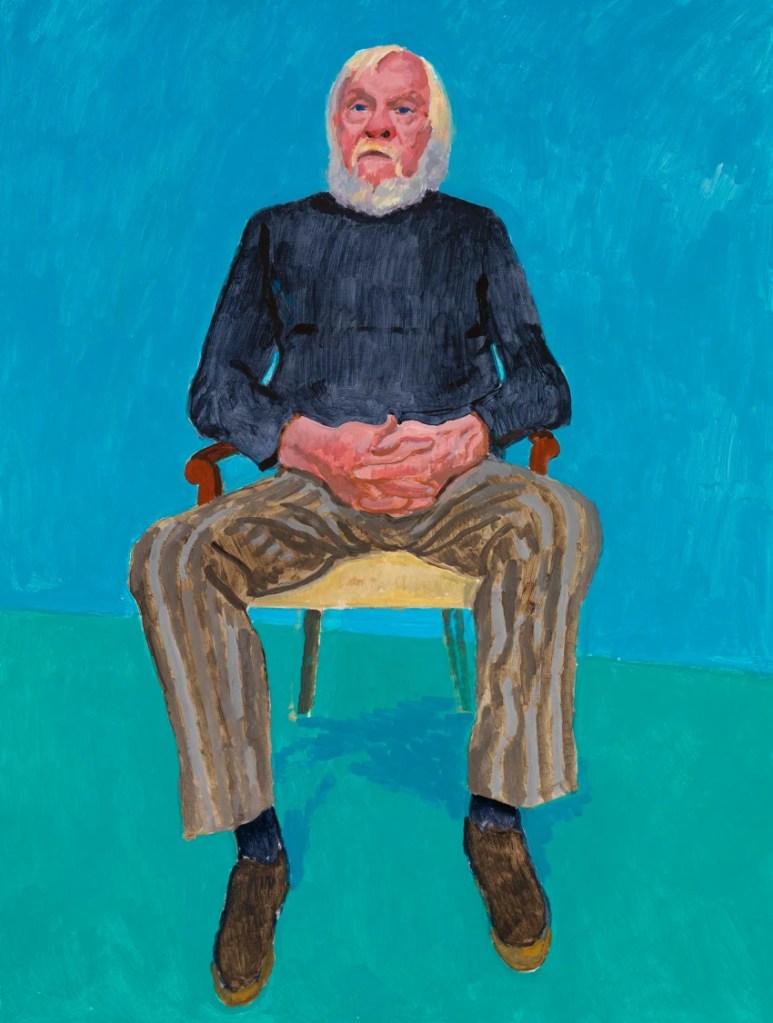
The above portrait is of John Baldessari Artist and was painted on 13th,16th December 2013. Painted in Acrylic on canvas 121.9 x 91.4cm.
The other artist that I came across when on painting 2 was Claudette Johnson. I accessed the following image which includes the blue background. I think this is interesting in terms of composition as the male in the picture isn’t fully in the picture. It’s title is Drawn Out but there are no dimensions.
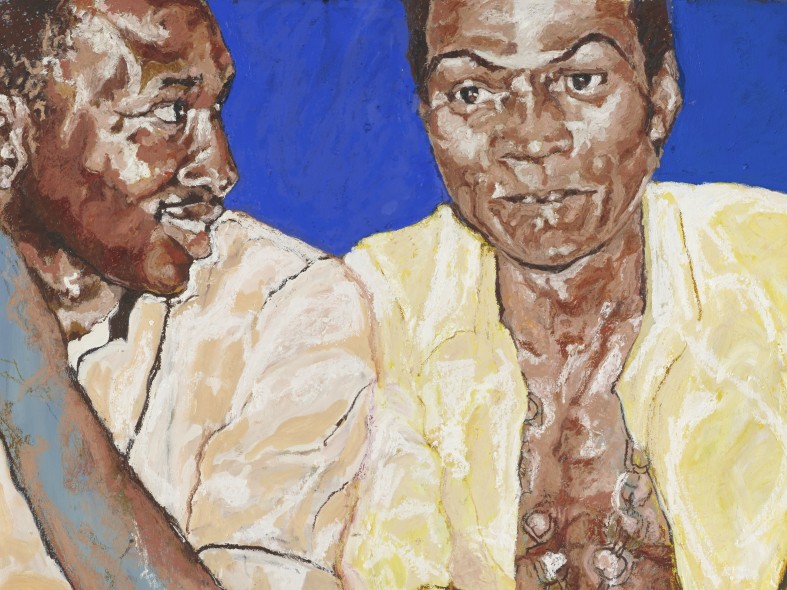
https://www.ortuzarprojects.com/artists/claudette-johnson#tab:thumbnails Accessed 30/12/23
Exercise 1.2 Conversations
I think I covered some of this section in the previous exercise but looking at this further I am finding that I am already encountering a lot of people from different disciplines in regard too the project I’m developing. I have been talking to various Health Care personnel and am in touch with doctors, nurses and teaching personnel. Part of the Child Protection work also involves police personnel too. As I read the inquiries I cannot help notice that the recurring theme is a lack of effective collaborative working between agencies and different disciplines as a huge factor in why a child isn’t protected. How these different disciplines see each other conjures up ideas of visual images. However these views of each other may well be a factor in the failings. I may need to look at such visuals.
The interior voice
I believe I have quite a wide range of interests but my main issues are about injustice and whats happening in the world around us. I already have project 2 and 3 in mind but these will depend on the success of this one. I have a lot of personal interests such as antiques and rummaging around antique and collectors fairs. I collect fountain pens ancient and modern and I’ve not long sold an old Morris Minor. I love all kinds of music from classical to pop. My other passion is visiting places of interest and walking. In this regard I’m a member of the National Trust and English Heritage. People are however my primary concern and it is so important to have good friends. I do sometimes bring some of the other interests to my practice. For example I buy old frames from antiques fairs and renovate them for my work. I have also got on my agenda a relief sculpture that I plan to update and sell. This also prompted me to undertake a relief sculpture in my body of work. There can often be creative overlaps in what I do. I’m never short of ideas but can be short on time to execute them.
The unknown voice
As already stated above I am already creating and fostering a network of useful people in my processes of research and my survey. As I begin to work on my questionnaire, I am very mindful of the ethical consideration around who I involve, how I frame my questions and above all how I care for any participants that are willing to take part. I must also consider my audience, what my intention is in regard to how the work impacts on the audience and I shall take into account warning notices. As I work through ethical issues on the OCA Enterprise Hub I shall prepare the necessary risk assessments and submit my plans and survey questionnaire accordingly.
I checked out Katie Paterson’s website. It was really good to see such collaborative work and the process of how her ideas unfold and are determined and realised in her practice. The literary project and the tree library to be realised in a hundred years time was so imaginative and innovative. A fabulous idea. I also enjoyed how one of her ideas about listening to a glacier transpired with microphones being immersed under water.
Research Point.
I looked at the resources on the Wellcome website and downloaded their information, however while they are concerned with health their stance seemed to be more about infectious diseases and general well being. I can’t see them funding my controversial project.
I’ve also downloaded the suggested reading list.
 Endless Possibilities