Exercise 1.1 Planning
I’ve considered the various formats for the 5000 word assignment and I also as suggested reflected on my SWOT analysis. I feel reasonably confident that I can improve on the written work if I choose the written assignment, but I am also considering a presentation. In any of the choices you still have to include the full bibliography and referencing and all of the contextual information so you don’t lose the structure. I have already started to formulate my question and I have been following the book How to write about contemporary art by Gilda Williams. It really helps you think about keeping the question simple and how to develop the structure and framework for the essay. I also attended the recent workshop run by Lydia Halcrow on writing the critical review and it was really helpful. I was able to revise one or two points following the workshop. Having the question formulated is helping me to be more focussed in what I’m doing and my timeframe.
The presentation would be in the form of a slide show and voice over. I have already completed a PowerPoint presentation at the beginning of the course and it would mean revising and building on that structure I’ve already started. I am determined to improve my video skills too and I think you can embed a video into a presentation. As I look to my SWOT analysis I pick up on the fact that I can be quite resourceful and determined. I usually rise to a challenge and I have gained confidence in the last year or so in regard to my artistic and creative ability.
I’ve already been gathering a lot of research material that I’m keeping in various folders such as the research on different artists. I shall link this to my examples of the body of work with an analysis and comparison about the methods, materials and techniques used in their work and importantly the messages the work conveys to the viewer. While I shall be using as one of my main sources the child inquiries, I’ve also got several books and articles that relate to the work and serve as contextual research.
Some of the relevant books and materials so far include Matters of Care by Puig de la Bellacasa. This explores Care in the wider sence. Derrida Reframed, A Black Gaze by Tina M Campt, Kentridge Catalogue RA, Marina Abramowitz catalogue RA, Magazine articles on Courtroom drawing, Plato’s Cave Allegory as this will be relevant, Painting beyond itself and Introduction to Semiotics. Another book is Is it art by Cynthia Friedland. This book is on our book list.
Whilst not an expert on semiotics I thoroughly enjoyed exploring this in Visual Culture and I can see it’s relevance. The Real World Research I can’t seem to access the full version in the library at OCA. I have however managed to download the article pages 13-41 for the next exercise. I also want to include some Significant Harm Threshold, explored in Adcock and White. Children Act info around Safeguarding. I have downloaded lots of information around artists too such as Marlene Dumas, Kolwitz, Fisher, etc
In regard to ethics I have also obtained copies of all the relevant policies held on the website of OCA/OU.
I do believe I have a lot of information already but my priority is to read up sufficiently on the inquiries and once analysed along with the Robson information will determine more fully the style of questionnaire I shall develop.
Exercise 1.2 Making connections
Despite trying all day yesterday to access the suggested text by Colin Robson in Real World Research I could not access a third edition copy to download or buy. I could see the book and text on the OU library but I didn’t have access and its not situated or available on the UCA resources. I have already created a folder, read and downloaded all the relevant OU policies on good practice in research. The code of conduct is vitally important and to be respectful and sensitive to any participants. I also attended the Future Learn course and have their suggested content for participants who take part in a questionnaire. I try again to download a copy of the text by Robson and I manage to download on my Surface. The article gives a good overview of the types of research that may be applicable to my project. At the moment I believe a multi-strategy design might be applicable with a mixture of qualitative and quantitative approaches but my reading outcomes may affect the choices. I need to access the book by Robson as it refers to causation and chapter 6 and page 117. This is very relevant to my project so I will try to obtain from the library resources/librarian. The chapter provided is very informative around which options may fit my project best but that page could be very relevant.
Exercise 1.3 Introducing research methods
Having considered the different research methods available I would be taking the Emma Powell’s bricoleur approach. At initial exploration of the various methods Biographical/life history research will apply as I am analysing the various and numerous case studies. Reflective practice will apply as this allows me to test out theories, my own ideas and assumptions. Realism and Real world research applies in regard to me using real field practitioners to gather the necessary data. I also include semiotics as this has value in regard to more contextual research around artists work and conveying meaning.
As we explore further the theoretical frameworks I shall link the reading of signs and symbols in artwork to Deconstruction and Derrida. I will also link this to Plato’s Cave, shadows and belief systems. Feminist theory will also be relevant as will psychoanalysis. Part of my exhibition includes an eye contact exercise exploring power adult versus child. There is also a scripted performance. I shall include Marina Abramovic in my critical analysis around use of performance and psychological themes. I need to explore Judith Butler.
I found the following information by googling ‘who invented qualitative research.’ https://www.bing.com/search?q=who+invented+qualitative+research&form=ANNTH1&refig=0375caed5f1243e6b206d7e505c5886d&sp=1&lq=0&qs=SC&pq=who+invented+qualiti&sc=9-20&cvid=0375caed5f1243e6b206d7e505c5886d
Paul Felix Lazersfield
Paul Felix Lazersfield is considered the father of qualitative research1. He introduced the world to unstructured interviewing and group discussions, and stressed the importance of answering the important ‘why?’ question1. Glaser and Strauss, influential members of the qualitative research community, pioneered the idea that theoretically important categories and hypotheses can emerge “naturally” from the observations a qualitative researcher collects, provided that the researcher is not guided by preconceptions2.
I also gained more information from the website below.
https://oliconner.medium.com/the-history-of-qualitative-research-f6e07c58e439
As indicated Paul Felix Lazersfield invented the qualitative research model and his main concern was the ‘why’ question. This in itself figures largely with my question and my letter to the dead children. My opening sentence being Why Oh why do you children die? It’s interesting that Lazersfield was able to demonstrate how psychology could form the basis for understanding human behaviour. The more I learn about the research it is important to note that I shall be gathering two lots of data. The first set of data will be an analysis of my child care enquiries. While there has been lots of these over the decades I would imagine that no one has actually analysed each one and gathered their collective outcomes. This in itself could mean that I am breaking new ground and there may be some very common themes. Whilst I do have some theories about why these children are dying I must be careful not to have any preconceptions as the above text indicates. As I explore the research method further there are a lot of different methods of collecting the data and also how to analyse it. When I clicked on the word preconception above I was taken to the Wikipedia page which introduced me to thematic analysis. It is clear that there is always a counter argument about using a certain approach but the thematic analysis seems to be more suited to what I’m exploring. It emphasises identifying analysing and interpreting patterns of meaning or themes. Further and under the description of thematic analysis it states that This method can emphasize both organization and rich description of the data set and theoretically informed interpretation of meaning.[1] Thematic analysis goes beyond simply counting phrases or words in a text (as in content analysis) and explores explicit and implicit meanings within the data. I’ve saved this page to favourites.
As I read further the thematic analysis may be applicable to analysing the inquiries and the questionnaires that I intend to distribute to health and social care personnel might be linked to more of a phenomenological approach. This is more geared to participants perceptions, feelings and experiences as the paramount object of study.
The History of Qualitative Research | by Oli Conne…
Qualitative research – Wikipe…
As I look also at the various theories and theorists that will underpin the framework and my research, several names appear that I am familiar with such as Semiotics and Pierce and Sassure. Indexical linking is something to consider in regard to the difficult subject matter. It is all about bringing in some of what I have already learned as well as new information. The concept of realism brings to mind Baudrillard and Derrida. The latter really had an impact on me and I loved the concept of what isn’t there in art being as important as what is. There is a good link there in regard to how the children have been invisible. Not seen enough etc. The psychoanalysis theorists will also be crucial as I am looking closely at the effects of a work of art on the viewer.
Exercise 1.4 Theoretical perspectives.
Although I completed the map below I feel quite confident with the way I am progressing. I do believe I’m at the stage where I have already gathered a lot of information and as suggested in exercise 1.3 I feel quite confident that I do have a firm structure or framework from which to develop my ideas and the essay. My main concern is to take time to read more inquiries and to formulate my questionnaires and analysis tools. What I need to check is any permissions from OCA/OU quite soon. I have a range of health and social care practitioners for a small sample survey surrounding my primary question why oh why. I shall be building into the information sent to people the necessary safeguarding and confidentiality issues.
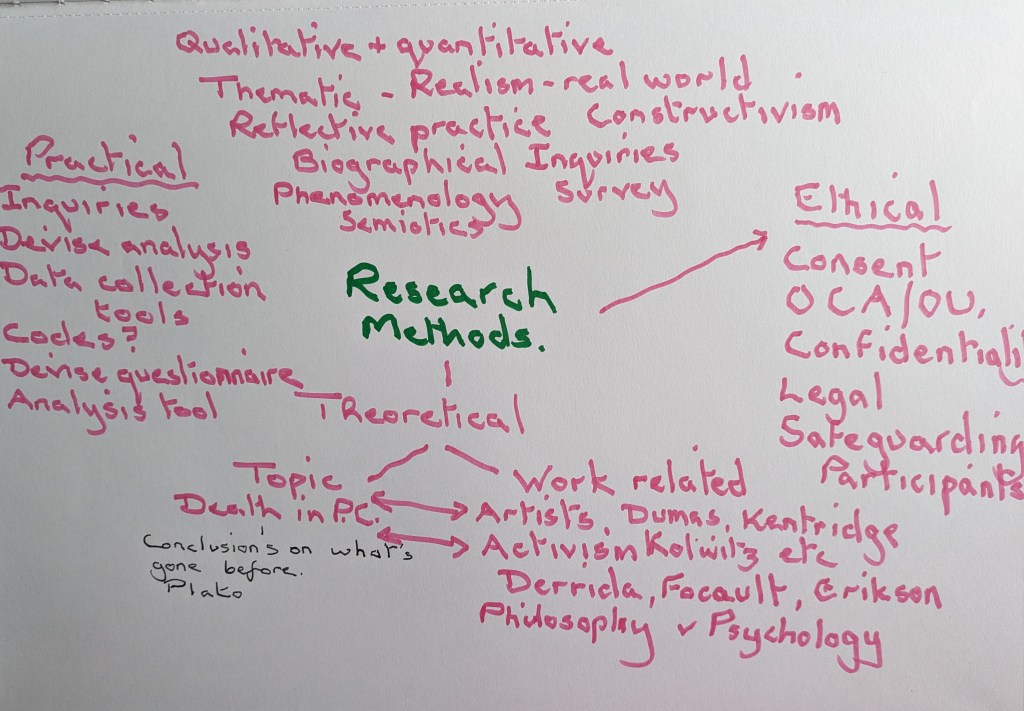
What I haven’t included on this plan is the other main elements related to the exhibition such as partner agencies and the other themes in the exhibition.
 Endless Possibilities