Project 1a Art as Life
It is really great to be on part four and my work is progressing well. I researched the H&D cafe. What a fabulous idea. Art and food…what can be better! It’s a great concept and there seems to be a huge commitment from the various artists, also supporting other artists even to wait on tables. I’m going to undertake the POP up shop again this year. I am undertaking for charity again but it is a great way of getting known in the local community. The workshops will be different and fewer as it was quite full on last year. I’m undertaking painting, resin work and pyrography. Yes I’m burning up wood! I shall also do a live interactive demo. I tested this out at our local Friendship group of around 50 to 60 people. It went well and there will be fewer people in the shop. The H&D group were really inspiring and energetic. I would wish them every success. The questions in the introduction part I have included below as I think its important to draw on these here. I do feel I’m at a crossroads with two forks. One direction is about my passion for justice and humanity, hence the project I’m doing and the other is about utilising other skills and tools in order to establish myself as a local artist. Doing the exhibition in the Pop up Shop does help with this and in this regard my work feels as though collectively it is multi layered. In between the difficult drawings I’ve managed some pastel work, resin based work and pyrography as I mentioned above. I’m beginning to realise that I can do various things fairly well. The body of work relating to the project however is my primary concern. On 7th April I presented to my peers a sculpture that will be part of my exhibition and I also presented a drawing about communication or should I say lack of it. The feedback was very positive. There was a comment about the sculpture that resonated with me. Although I have plans to define it more in regard to the features the comment was about leaving it as though it was unfinished and child like. They commented further that this reflected how the lives of the children were unfinished. With regard to the communication drawing I was a bit unsure about the need to work at it some more but the consensus was that it was complete and was poignant in its message.
First, in order to discern which parts of your work you’re going to present to
peers, consider the following points:
● Which parts of my work best communicate my personal theme and ideas?
● How does my body of work integrate elements from my Research course?
● What areas of my body of work could I usefully canvas opinion on to help
my creative decision-making?
● What part of my work would l like affirmation on so that I can confirm I’m
going in the right direction?
The Bloomsbury Group
I think this group of artists were incredible. I would just love to have been part of this group. Such a mix of diverse richness of artists including writers, sculptors and painters. I am not writing much on this group as I plan to visit Charleston in the summer. I love the work of Vanessa Bell and I hope to paint one or two interiors and still life works in her style.
Exercise 1.1 The Everyday
As I develop as an artist my work will be quite eclectic. My journey through life’s twists and turns will inevitably affect what I am going to create. For example the project on child deaths and how this relates to my previous working role. My previous body of work in Drawing 2 also related to people and the local Transition Town and following their foraging map. I think I have a good balance of where my life will reflect on important issues. I do feel already that my art is embodied and entwined in my life. The project and body of work has been quite demanding and at times very difficult to fulfil but it is beginning to come to an end. Doing other things like pet portraits and other paintings has been helpful in providing at times a necessary diversion. If I do get the opportunity to exhibit the work in a tier 3 gallery that would be my dream. I will remain optimistic on this until I’ve completed the work. A tier 3 gallery is a top gallery like Hauser and Wirth, or the Tate. This would be ideal to do the children justice. My options for other work is to be more active on Instagram and produce portraits amongst my other subjects of interest. I am never short on ideas either through news coverage or looking at the local landscapes, cityscapes. My list could be endless. If I get through the course I shall look forward to collaborations with others and to creating work more for myself. My work processes and materials are quite diverse and I enjoy not being pigeon-holed into one genre or subject.
Project 1.B Taking Stock
Appraisal and Evaluation
This is a good exercise to undertake but I find that I did plan in the first instance what works would go together. In this regard I have looked at scale and size. I also considered colour and which pieces lent themselves to colour. I imagine my exhibition to be a transitional walk through. In this regard I have compiled a directory of images in the sequence that I would wish them to be viewed. I have three drawings that are completed in indian red conte-crayon line and wet brush. These will be framed and I have purchased these in readiness. Two of these are complete and the third I am yet to do. These three drawings one in a frame 20x16ins as a portrait and the other two in a frame 70 x50 cm. These works will be at the beginning of the exhibition after peope have read the warnings and will be aware of what the exhibition is about. Alongside this will be the birth scene in colour and also framed and this is about celebrating the birth of children. I will also have in the early part of the walk through the sculptures on elevated platforms. As the work progresses the charcoal works of the main narrative and children being seen in vulnerable positions would be next. These are the more emotionally charged works and I hope that their presence isn’t too distressing for anyone. Safeguards would be in place as already indicated. The canvases are all the same size 36x24ins. These will be hung unframed. I anticipate the child portraits to be next as these will provide a sense of the reality about what happens to the children as they are real children who died. The final piece will be the flower window that reflects the remembrance of all the children who have died. I have prepared a photo list in sequence.
Exercise 1b Ten Questions
My ten questions would be as follows.
- What motivates you to choose your subject.
- Is your own life or lifestyle reflected in your work?
- What materials do you use in your work?
- How do you construct your work in terms of the process from the start?
- How long does each piece of work take to complete?
- Have you had professional training or are you a self taught artist?
- Do you ever get stuck for ideas for work and how do you overcome this?
- How do you manage your time to create work?
- How did you become successful and what was your journey?
- What is your working relationship like with galleries?
Research point
The artists I have chosen to consider how their work has changed over time is one of my favourites, David Hockney. Hockney has throughout his career maintained a steady and strong popularity. There have been different styles and trends. His early work focussed on the northern landscape. Hockney was born in Bradford and initially attended the Bradford school of Art until he went on to Royal College of Art where he studied under Francis Bacon and Peter Blake. Artists that had quite an influence were Pablo Picasso and Henry Matisse. Hockney studied architecture and in this regard his accuracy and compositional work is well accomplished. When he left this country for America he became famous for his swimming pool paintings such as A bigger splash. The other painting that is famous is the interior Mr and Mrs Clarke and Percy. Percy is the cat. What I admire about Hockney is how he moved with the times. He has embraced the technological age and now creates most of his work through use of his ipad. He is also well known for his portraiture. Celia Birtwistle was his main model over many years and I believe she was the Mrs Clarke. I include one or two images below.
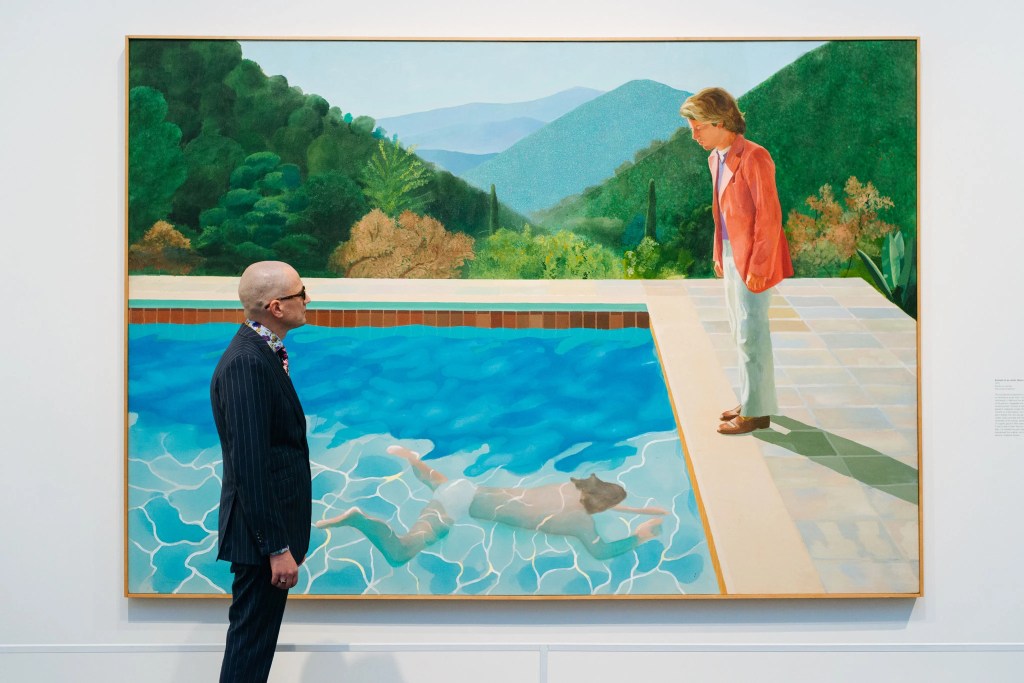
The above is an internet image by the New York Times. I include it with the man in the front as it shows the size and scale of the work. I love the use of a rich colour palette and he captures the shadows and glimmers in the water sublimely.
The other image I include is of a landscape with the use of the ipad.
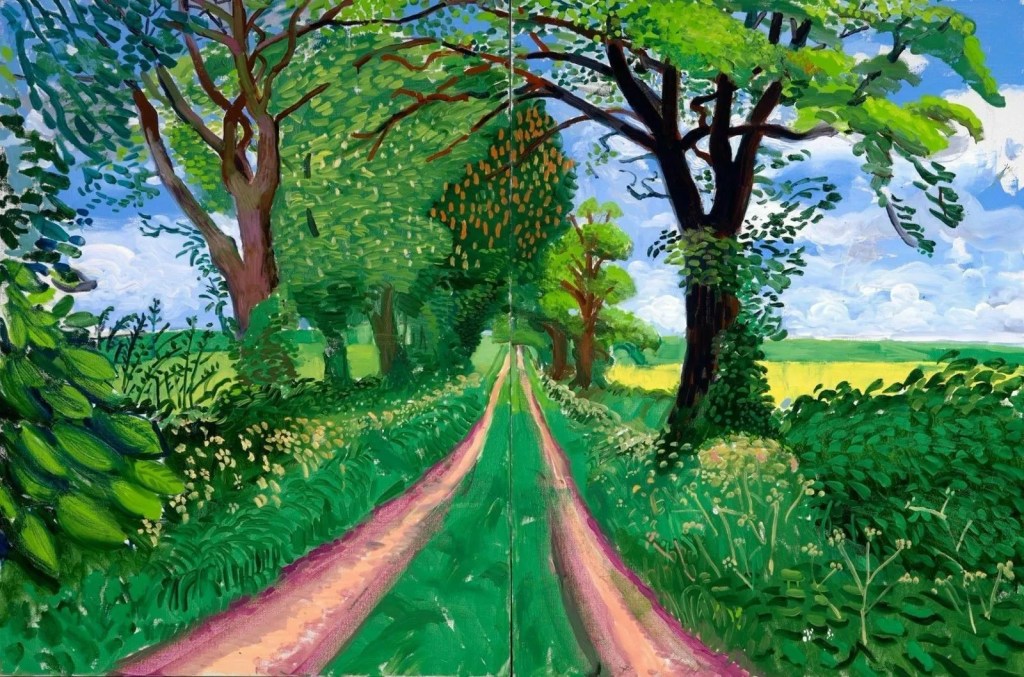
This image is again so vibrant. Who couldn’t live with this!
Project 2 Where have you been and how did you get here
Exercise 2.1
What is important for me to say here is about how I see my own work develop and it has two or three strands. The first is the social conscience. It has at times been very difficult to proceed with this project and my body of work. At times I’ve felt like giving up but I am not a quitter! The research and the survey have also been quite complex and difficult to pull together and evaluate. I decided after I met with the ethics committee not to pursue a venue for the exhibition until I had completed part 4. Completing the final piece – the large flower painting helped me through some of the issues. I also recently let another friend a teacher look at one or two of the works and he was encouraging and knew someone who would help with the video/camera work. I must see this through and include it in my exhibition. Taking up a cause or considering a topic to raise more awareness will be a part of what I do. It is who and how I am. At times I have really connected with the children and it is them that keep me going. I’ve thoroughly enjoyed the processes, working with charcoal and I know that my work and my drawings continue to improve.
The next strand is to take up portraiture. I am making a start in the pop up shop with dog/pet portraits. Connecting with the subject really helps and its has been good to do the child portraits.
The third strand is painting subject that I like. I do want to undertake a series of still life paintings and also a series of landscapes in charcoal and also in paint. The pop up shop will help me to get known as an artist at a local level. My mug shot has been in the Local Paper and the advert on Facebook and I shall raise money for charity again. What I would like to do but I am prepared that this wont happen is that I undertake an exhibition at a local level here in Somerset but then my exhibition might get to a level I gallery. My nearest is the Hauser and Wirth gallery in, Bruton, Somerset. Who knows..watch this space!
What is also important is what I have learned from doing the research and how this has helped inform my narrative. The visual images I have created in part from memories and personal experience, but also from what I have learned from the inquiries and government documents, the ethical considerations in relation to the caring role, and how swiftly society changes. Government forces and the free market economy has also contributed to changes in care and how it is now very business oriented. Care is also now very fragmented. I am hopeful that my narrative of visual images reflects the vulnerability of the children and I can achieve soon what I set out to do which is raise awareness about the situations these children can be in. I have tried to reflect in my writing the reasons for decision in my processes and making and I hope I have managed to put all the images in context with the research and the overall aims for the work.
 Endless Possibilities