Research Point
What is research. Research is about looking for something in a focussed and detailed way.
(Lupton, cited in Noble and Bestley, 2016:7)
It is interesting that we reflect on the work of William Kentridge and asked to make comments on his video Pain and Sympathy.
I have watched this before and have previously researched Kentridge in Drawing 2. I also visited his exhibition at the Royal Academy in December 2022.
Kentridge pays great attention to a lot of details in each frame. For example the oxygen apparatus and monitors used. We also see the curtains open with great precision. Each frame has detailed movement. What Is so inspiring is the respect he has for drawing the really gruesome images.
Project 1
Exercise 1.1 Approaches to research
The artist I’ve chosen is Barbara Walker. I had researched Walker during POP2 so I tried to source again the video I’d seen. She was interviewed by Anna McNay
I accessed the video on 9/8/23
https://www.studiointernational.com/index.php/barbara-walker-protest-and-remembrance-video-interview
Barbara Walker also works in charcoal or conte crayon. For her visual images she researches material from books, internet searches, the Imperial war museum and eBay where she found old post cards. My research themes will be similar to Kentridge and Walker. I watched Walker talk about one of her large scale charcoal portraits in the video interview. She will often use the same reference photo for different images or people. Her aim in protest and remembrance was to give power to black war personnel that were never given any recognition for the role they played during the war. Although done differently Kentridge will use the same original image but use it several times through the re-drawing and erasing process. I intend to use research photos from the internet and real children for some of the baby or child images. I intend to also use my own photos taken of me when I was a child. From the range of images I will create my own drawings in charcoal or graphite. Similarly to Walker I may source archival material from the Victorian era as there was a phase whereby during that period it was popular to take photos of dead children. Further in regard to Walker’s processes, she will scale up the images with use of a projector screen and then transpose these onto the wall that she will be drawing on. I have scaled up before but only with the use of drawing a grid. I’m not yet at the stage where I’m considering the size although I do want the images to be quite big for impact. In other works Walker has made smaller drawings. In one video I saw Walker wash out the drawing she’d made as part of the visual impact to create the figures nothingness.
I recently attended one of the Painting student’s Sue Parr’s exhibition in Eype, Bridport. I got to know Sue a little as we were both members of the OCA South West. What was inspiring for me and so helpful was the diverse range of related research to the body of work which was titled Just like a leaf. It was about the nettle. Seeing her research in practice and played out was just heartwarming and so reassuring. I really feel confident as I move forward and collate my own resources and research elements. I cannot believe how my previous work role as a social worker and my work now as an artist are colliding and making connections that I never imagined possible. My social conscience has kicked into gear and drives the two forces into my project. All of the elements through my experience as a trainer and practice teacher in social work also help me to encompass the additional elements of performance in harmony with my visual images.
Exercise 1.2 Flow of consciousness- Approaching new challenges.
Quick think
I used my sketchbook to quickly jot down my thoughts.

I listed these words quickly on the left in my sketchbook and then put them into the separate columns to undertake the next part of the exercise. See below my mapping of the words with arrows that interrelate for both sides. The fear is probably in combat with excitement.
What is interesting when I look at the words there are far more words and positive ones and so fewer on the right. This seems to suggest that I am clearly a glass half full person and I am always one to look and seek to remedy and overcome obstacles where possible. I am forever the optimist. The question related mainly to a new challenges and they were one word answers. In addition to the above and similar to the personal SCOR chart I will add a few other statements:
Strength I can be organised in gathering research material and I plan to organise the research under relevant topics or subjects.
Weakness On a practical level of creativity I often work in chaos and my studio can be very messy.
Weakness I need to ensure I make time for the drawing processes and experiments.
Strength I am resourceful and have a good network of knowledge people and information about my subject.
Strength v Weakness I am an ideas person but I need to ensure I am not over ambitious.
Strength v Weakness I an very enthusiastic and keen to progress my plans but I must ensure I take time to reflect more and evaluate the plan at each stage.
Exercise 1.3 Mind mapping
I completed this mind map before the course started as this project was beginning to unfold for some time and some of my research in Drawing 2 was related to this topic. As I work through the course material it is evident that we explore different ways of mapping. I do believe however that the maps are about a method that best helps us to realise and explore ideas. All of my maps will explore my different themes almost breaking down each segment or blue area.
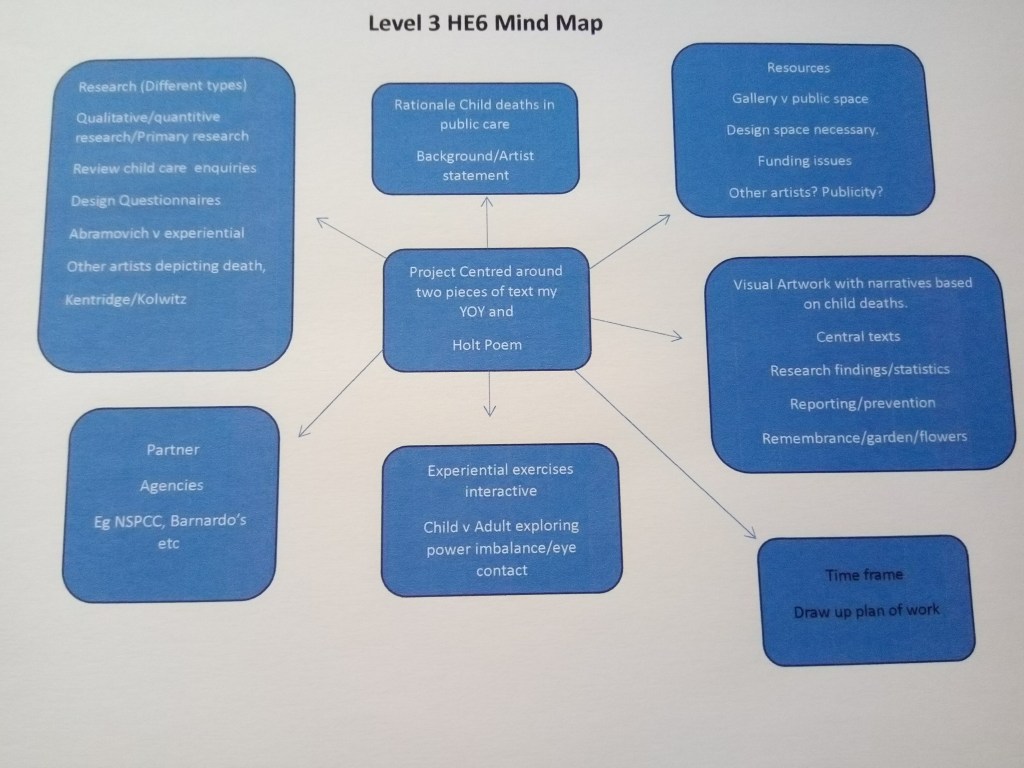
Below is my first map related to the above and my main theme is about the use of charcoal and information relating to my subject are the various artists both modern and the classics that have used the light and dark effects in creating very dramatic work. I intend to explore each item to build up my research base and for the research to be contextual in regard to my subject and my rationale.
Exercise 4 Concept mapping
Map No 1
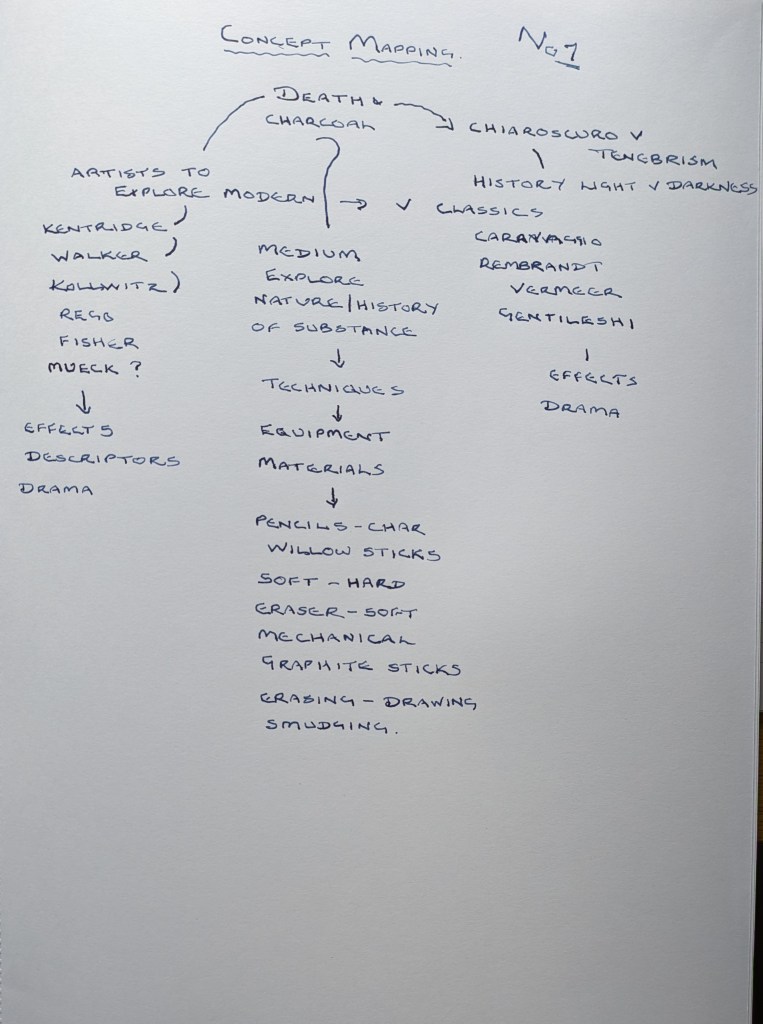
Map No 2
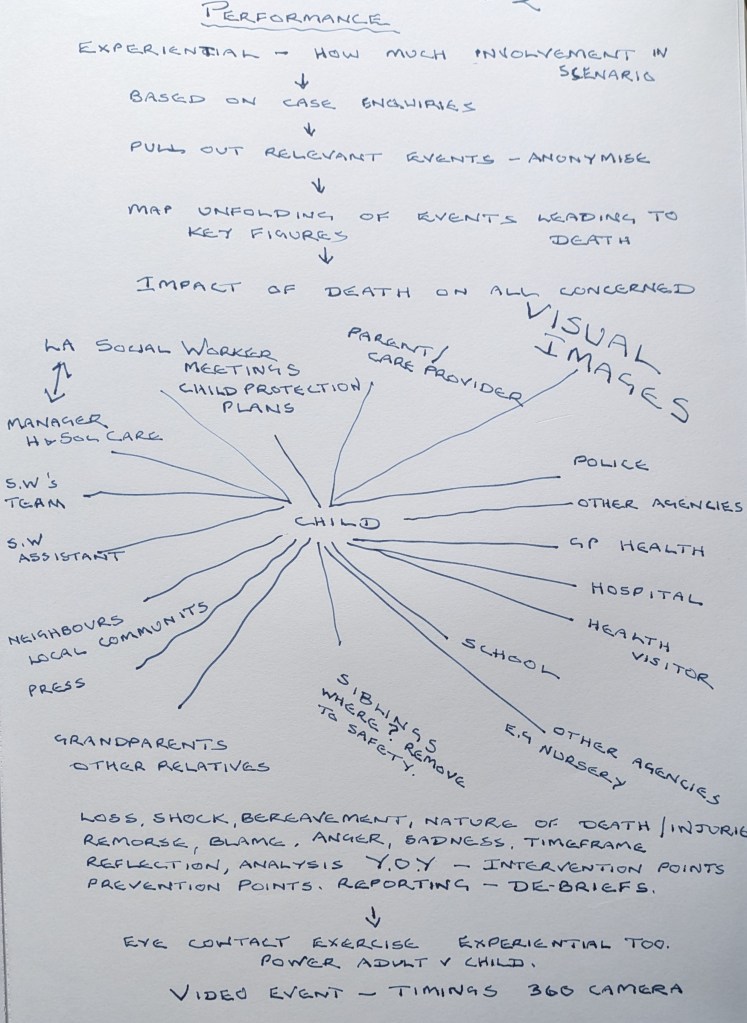
This map relates specifically to the experiential exercises and the performance. I intend to act out a scenario based on some real events from my findings but these will be anonymised. I will lead the scenario and pull in the various participants where relevant as the situation unfolds. I intend to video the event as the scenario may only take place once due to needing several people present. Having said that I know a few good volunteers that would be happy to help.
Map 3
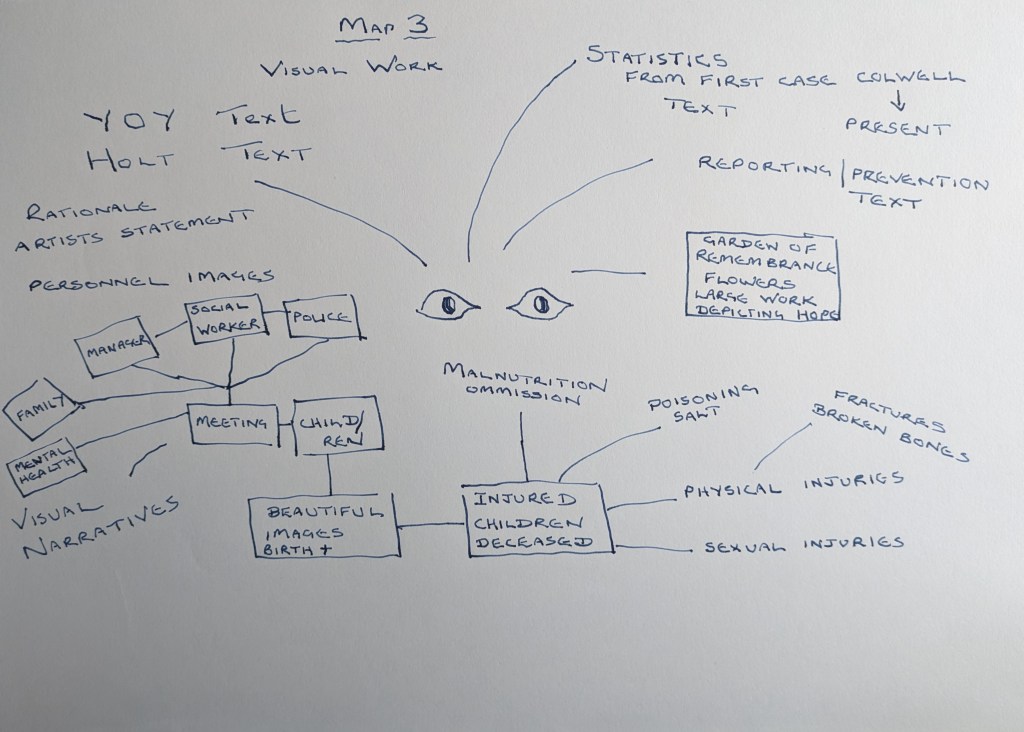
This map relates to all the visual imagery including texts, drawings and paintings. The aim is to create a visual narrative about how a child might die and who could be involved. This would then lead to the other sensory experiences through the auditory room and the eye contact exercise, through to the performance about a child’s death.
In my next map I consider the kind of experience the viewer will have of the exhibition and how they make the transition from beginning to end.
My map is below.
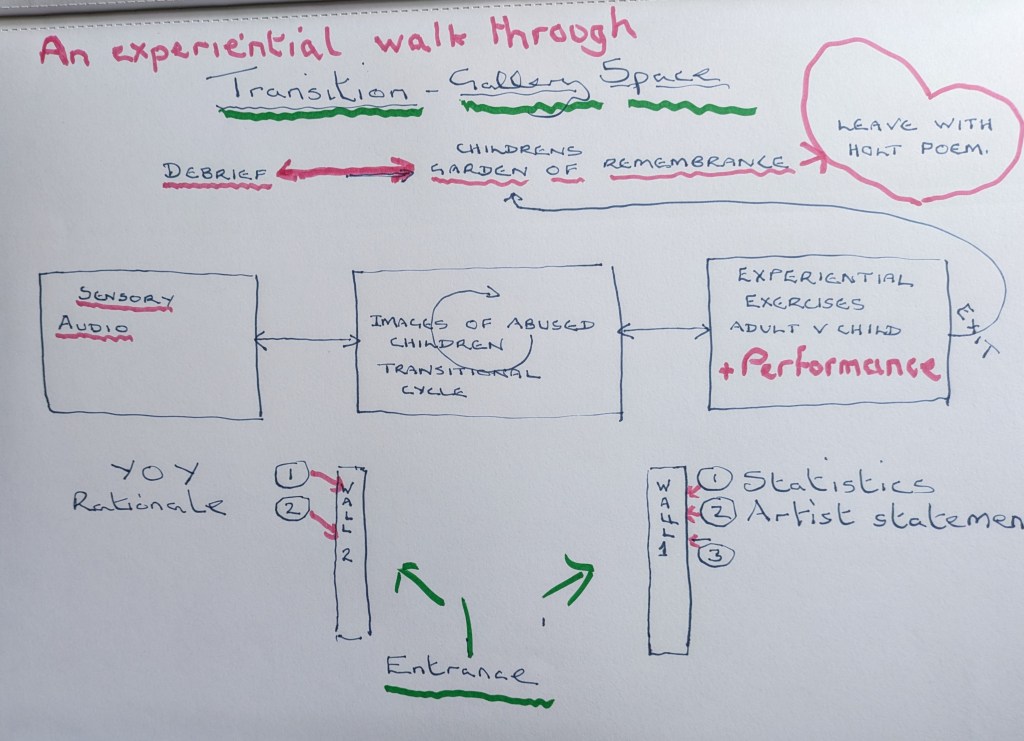
The mapping exercise has really helped me to break down my project and my work and to help visualise how it will all work. Having said that nothing is written in stone. I shall use these maps like a working tool and keep adding to them as other issues or ideas flag up. The last map is about the underpinning research. I have found that I have added to this as other thoughts and ideas are generated.
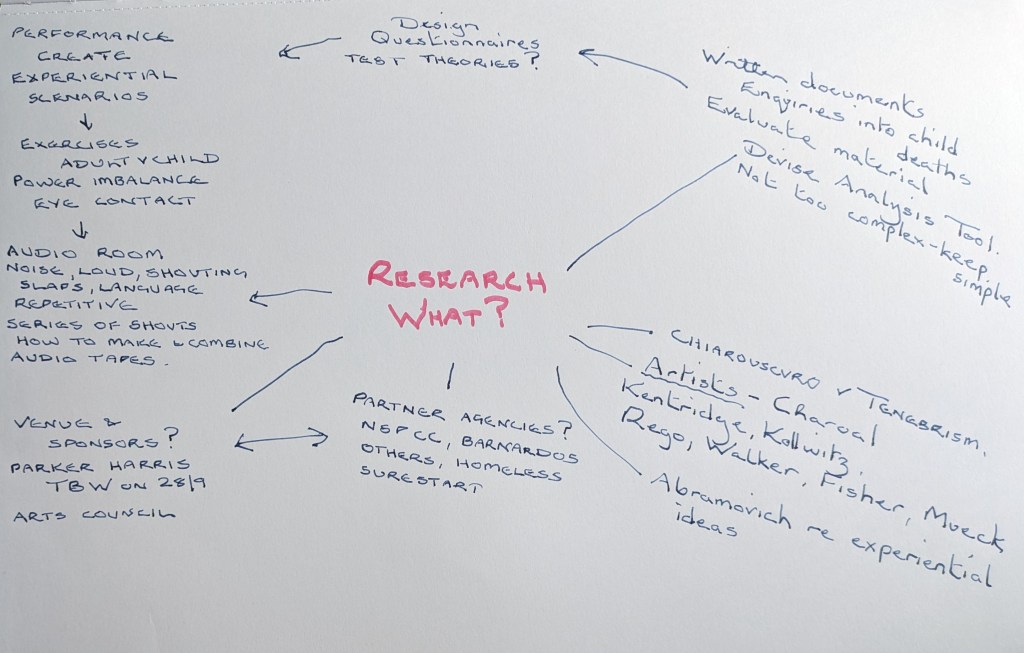
Exercise 1.5 Developing ideas
I’ve begun to undertake some practice drawings for my project based on my text piece YOY. Although I know I shall be completing some gruesome drawings I am starting with some fairly sombre drawings and drawings of children. I am using charcoal and although I’ve not practiced with or used this much I am also using pastels and pastel pencils. I’m also testing out the surfaces on one or two pastel mat boards as I’ve not used this surface before and I hope that it holds the pastel and it adheres to it well with overlays. The mat board is sized 35x25cm and is the same thickness as a mountboard. Using these materials which add colour to the work has also led me to research one or two courtroom artists. The same techniques can be employed with the pastel as with the dark charcoal. It is reasonably easy to rub in and out using the erasure and I have found good erasures that are harder than the putty erasure. I also have a fine line eraser which is like a propelling pencil and this works well too. I also want to add to my research Barbara Hepworth’s hospital drawings.
Exercise 1.6 Mapping sources
For this exercise I have decided to place all my maps around the central one I first drafted. I have placed these on the floor and have then taken a photo as below. I find that I am adding to my research as ideas flow. There is far more detail now on the page below in regard to contemporary artists who use text and another contemporary artist who works on dark charcoal images. I want to include a good range of artists. I’ve also added in some primary sources in regard to books.

On reflection I am really pleased and excited by the prospect of executing and bringing each element of the work to fruition.
Exercise 1.7 Artists and words
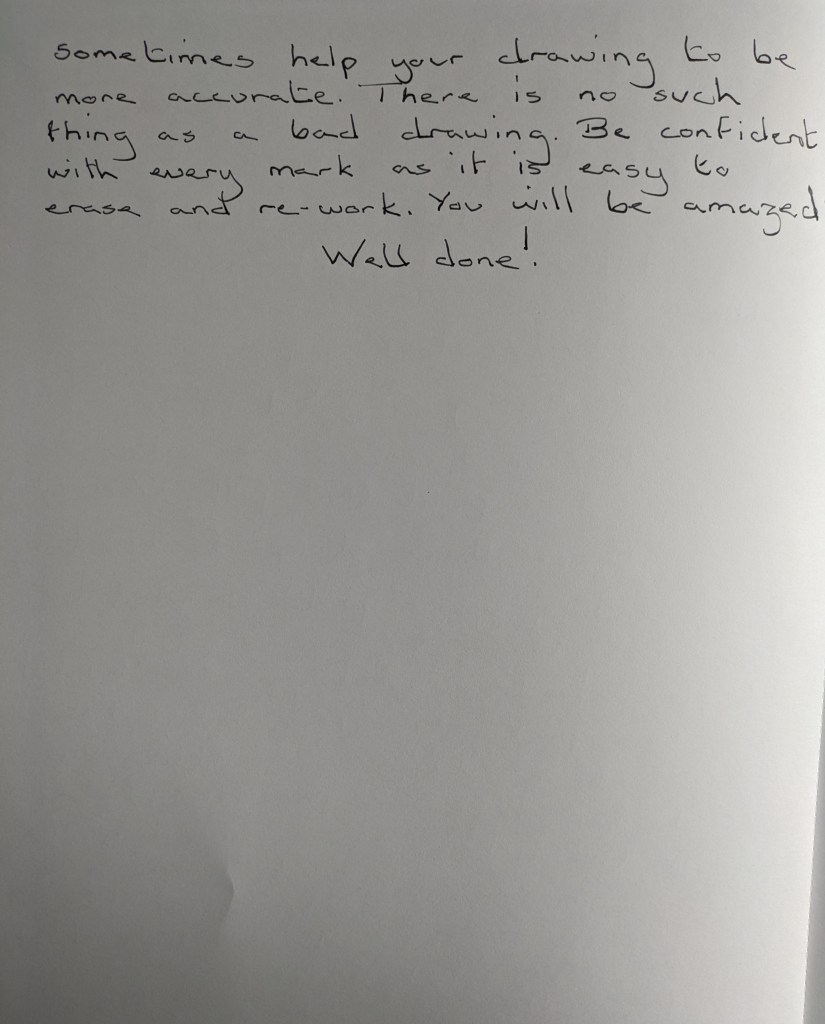
I include my instruction for making a drawing in charcoal and taken from my sketchbook. The exercise is useful as it reminds me that when I write about my work I need to detail everything I do in regard to materials, processes, analysis and then what I might have done better.

Exercise 1.8 What will it do for me
I’m writing this in retrospect as I have already based my work around a piece of text that I’ve written. In POP 2 I wrote a letter to the dead artist Artemisia Gentileschi. I completed it for a competition. It was quite a powerful moving letter as she had been sexually assaulted at a young age. I was also moved by another artist who had used numeracy to depict dates of deaths. Janine Antoine had also written a letter to her audience about what they encountered in her work. Robert and Roberta Smith used text very poignantly and very humorously. Having been impressed by the range and the manner that these artists used text I’d found it to be a very powerful and strong medium. My YOY text is a letter to dead children as below. I considered several options for the text and the one I shall use for the exhibition will be the hand drawn version as this style includes more of myself and it seems more personal.
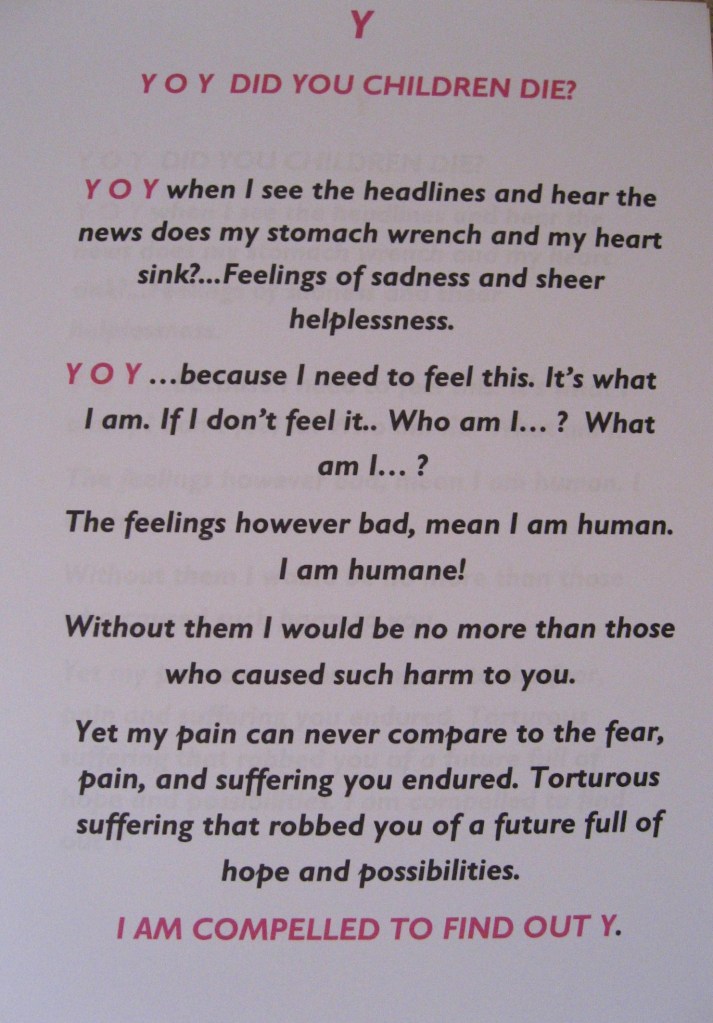
My project will include the research of these various artists around text and its use. I believe it is a good basis from which my project unfolds.
Research point
I read the text by Jaimini Patel that related to her work and the text is very thought provoking.
Exercise 1.9: Impressions
The text the artist has written is very descriptive and very detailed as it describes her processes and how she constructs the work. Each photo includes the same title so all of the images relate to one project. My first impression of the work is that the artist has gone to great lengths in regard to repetitive drawing techniques with the carbon. I’m assuming that the title that precedes the elements in the picture Measure refers to time and she tells us of her interest in the power of thought, gesture and movement. A lot of what she does relates to her processes. Another crossover is the act of setting light to the matches. Her thoughts are relevant to her actions and the time it takes to burn the matches? I think the artist talking through her work is helpful as it helps consolidate her own thoughts about what she is doing and these thoughts can generate other thoughts and ideas. There are crossovers in regard to the text and studio practice, For example as she describes the drawings she notes how the drawing process speeds up as the groove is more profound. She also comments when the drawing goes off kilter and she returns to the original groove. In regard to the tape she describes the anticipation of what it might be like part unrolled in contrast to fully rolled. Overall I think the work is intriguing but her intentions are only understood in context with reading the text.
In regard to writing about my own work I am learning to be more critical about my own work and to be more descriptive about what I’m doing and why. As I pick up my materials they have become my thinking and what has transformed my work is the fact that I’m not afraid of where the marks on the surface will lead me. The erasure and rubbing in and out is serving me well and the more descriptions and writing about my work does help me to reflect and understand it more fully. It also helps generate more ideas around how it could be improved. My only concerns are about how repetitive this might become for the reader. Writing about my practical work and creating text to become part are both integral to what I am doing and the direction I am headed. I do feel reasonably confident as I move foreword and I know there lot of work ahead.
Project 2 Identify resources
I feel reasonably comfortable with the wide range of resources I can use for my research. I keep building on this in my plans and the range of resources includes a good balance of primary and secondary sources. I also had a look at accessing the library resources. I do have three or four books at present that will be relevant and my other sources of primary resources will be the Inquiry reports which will form a large part of my reading and analysis.
Exercise 2.1 Online search
I’ve downloaded the OCA Harvard referencing document and this has been updated and improved so I think this will be helpful. I am already making document folders on my PC of the different chunks of research, whether its an artist or a document. I title thins so that I can find easily. I’ve also familiarised myself a little with the new library online.
2.2 Searching the Library-Local library search/access to inter-library loans.
It was good to familiarise myself with the range of library resources and they seem quite easy to access.
Exercise 2.3 Physical search
I recently attended The OCA student Sue Parr’s exhibition and it was really helpful to see how in practice the research and the diverse range of it can underpin our work. Her exhibition helped me to understand how the research and the different strands underpin all the work.
I am also planning to go to London for the Marina Abramowitz exhibition that is taking place at the Royal Academy. I plan to go on 28th September 2023. Her exhibition may be relevant to the performance element of my exhibition. I’m not sure what to expect and I don’t think she is even there from the information I have but I am going with an open mind! Last December I visited the RA and saw the Kentridge exhibition so I need to check if I can write about this too. I already have several Inquiry reports in regard to the death of children so I anticipate starting to read these soon.
When I visit the Trinity Buoy Wharf exhibition also on 28th September I hope to network a little on possible gallery resources and finance for supporting the exhibition. I am going to be brave! I have begun to check out possible exhibition venus and these are in my plans/maps.
Exercise 2.4 Skim-read initial key texts and resources.
I’m familiar with skim-reading and believe I am gathering a range of relevant material.
 Endless Possibilities