Exercise 1.1 Working Space
Task: Research into the studio of Francis Bacon and write a short 300 word analysis of what you have found in your learning log
The image of the studio is below and was downloaded from the link provided.
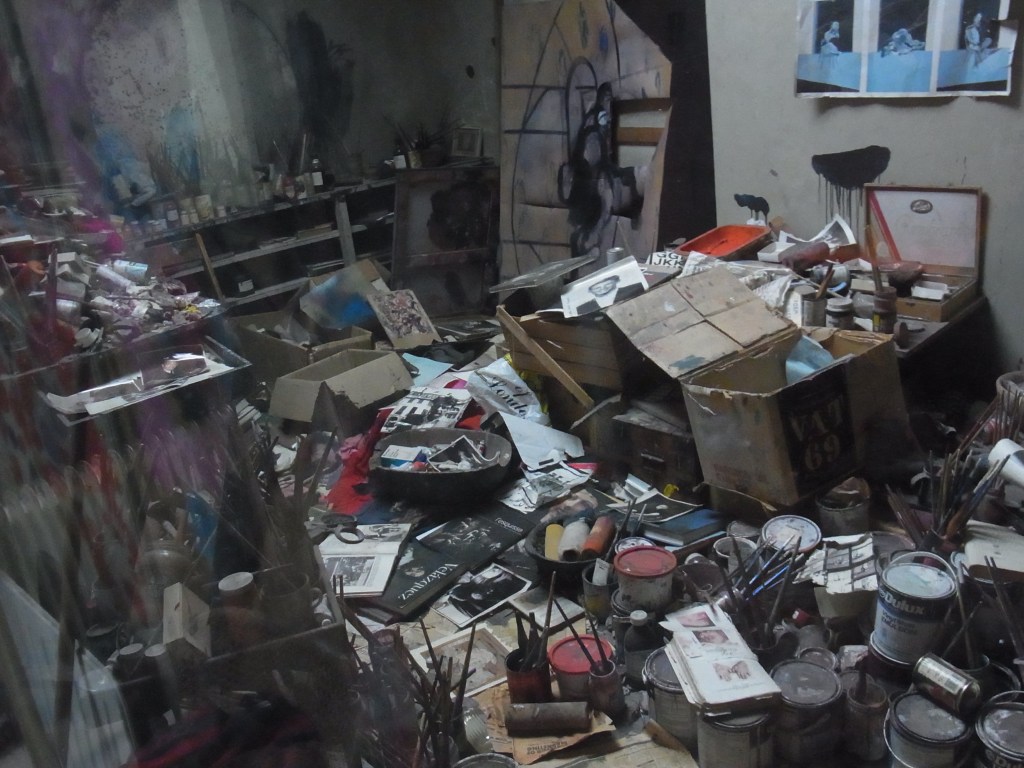

Our first impression is to simply visualise and encapsulate in our thoughts mess, clutter and chaos. In order to consider the image more fully and what it represents I researched Francis Bacon in more detail. I managed to find a lot of information about Bacon from the website below following my google search.
Studio | Francis Bacon (francis-bacon.com)
The url is https:/francis-bacon.com/artworks/studio
There was such a wealth of information about the artist and I was able to download a lot of text from the website for future reference.
Gathering more information about the artist and glimpses into his life it helps us understand more fully the image. Bacon was born in Dublin in 1909 and he died From his early turbulent upbringing through to adulthood and his latter years it is important to note several important aspects about Bacon’s life. Similarly to Tracey Emin’s unmade bed we can understand and appreciate the work when we know more about her difficult history. Bacon too had a very difficult upbringing. His father very belligerent and argumentative and his mother very cold. As he grew older his emerging homosexuality also caused great difficulty for his family. Over the years his art changed quite dramatically too and was quite diverse. His relationships were also quite passionate and turbulent. It is also important to note that similarly to his studio his life and lifestyle was also quite chaotic. The very visually chaotic cluttered studio resonates with me as my own is often very cluttered however that is where I feel at ease and comfortable. On the website the same photo of his studio at 7, Reece Mews, London is included as the front page but from a slightly different angle. The gallery was recreated in Dublin his homeland after his death. The curator and Art Historian Margarita Capock helped in this process and she knew Bacon when he was alive. However messy the studio what is evident is that Bacon’s creativity flourished and he was a very successful artist. I include this comment that he made himself about the studio in the essay on the website from Margarita Capock. ‘I feel at home in this chaos because chaos suggests images to me.’ Capock comments on such an array of materials in the studio which were sources of inspiration for his work. These ranged from books magazines and articles on various subjects including wildlife, sport, crime, history, bullfighting, and photography. Bacon died on 28th April 1992 from a deteriorating period of health following the removal of a cancerous kidney in 1989. He died in Madrid and was looked after by two nuns fro the order of St Mary.
Research Point 1
The article by Caitlin Jones clearly opens up the different dynamics and other opportunities for the artist if they utilise their computer as a studio. Those that undertake digital art for example eliminate the use of a room to create and utilise with additional physical materials. Other artists however are becoming more conversant to utilise both. As Jones points out there are many online demonstrations of artists working and providing tutorials. This is also a way of marketing themselves and their art. The online gallery also provides a more virtual world where you can just upload your images for display. What I hope to achieve for myself is a website that will act as a gallery, a bit similar to our blogs but with payment links. Using a space like we’ve seen with OCA such as the white cube may be an option but I initially want to undertake a walk in exhibition. The article also mentions how we can collaborate with other artists so easily on line too. There are a lot of options and possibilities. I do want to get to undertake some demonstrations. I’ve done one or two in person ones and I am now getting to grips with the camera work as I’m trying to undertake an animation.
The second article Roszika Parker’s Housework is a feminist article depicting women working creatively in the home but also helping them to reflect on their identity as women. The article came under criticism as might be expected at that time. It was first published in 1975 but I can’t help think that we haven’t really moved on much from then to present day.
 Endless Possibilities
